
Homemade Food vs Packaged Food
Neither homemade food nor packaged food is inherently good or bad; while cooking at home offers better control over salt, oil, and sugar, packaged options like oats or canned beans can easily fit a balanced diet. Rather than relying on simple labels, evaluating specific ingredients and preparation methods is key to making healthier choices.
Abhinav Sharma
Introduction
Food choices have become more complicated than they used to be.
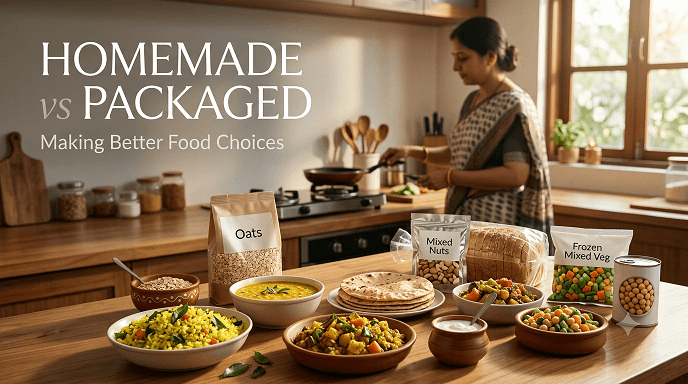
A typical kitchen may contain fresh vegetables, grains, pulses and spices alongside packaged bread, breakfast cereals, snacks, sauces, frozen foods and ready-to-eat meals.
At the same time, busy schedules mean that packaged food can sometimes be much more convenient than preparing everything from scratch.
This raises a common question:
Is homemade food always healthier than packaged food?
The short answer is not necessarily.
Homemade meals can make it easier to control ingredients, cooking methods, salt and added sugar. But a homemade dish can also contain considerable amounts of oil, sugar or salt depending on how it is prepared.
Similarly, packaged food isn't automatically unhealthy. Some packaged foods—such as plain oats, unsalted nuts, frozen vegetables, canned beans or pasteurized dairy products—can fit comfortably into a balanced diet.
The more useful approach is to look beyond the word “packaged.”
Let's explore the differences.
What Makes Homemade Food Different?
One of the biggest advantages of cooking at home is control.
When you prepare a meal yourself, you generally know what goes into it.
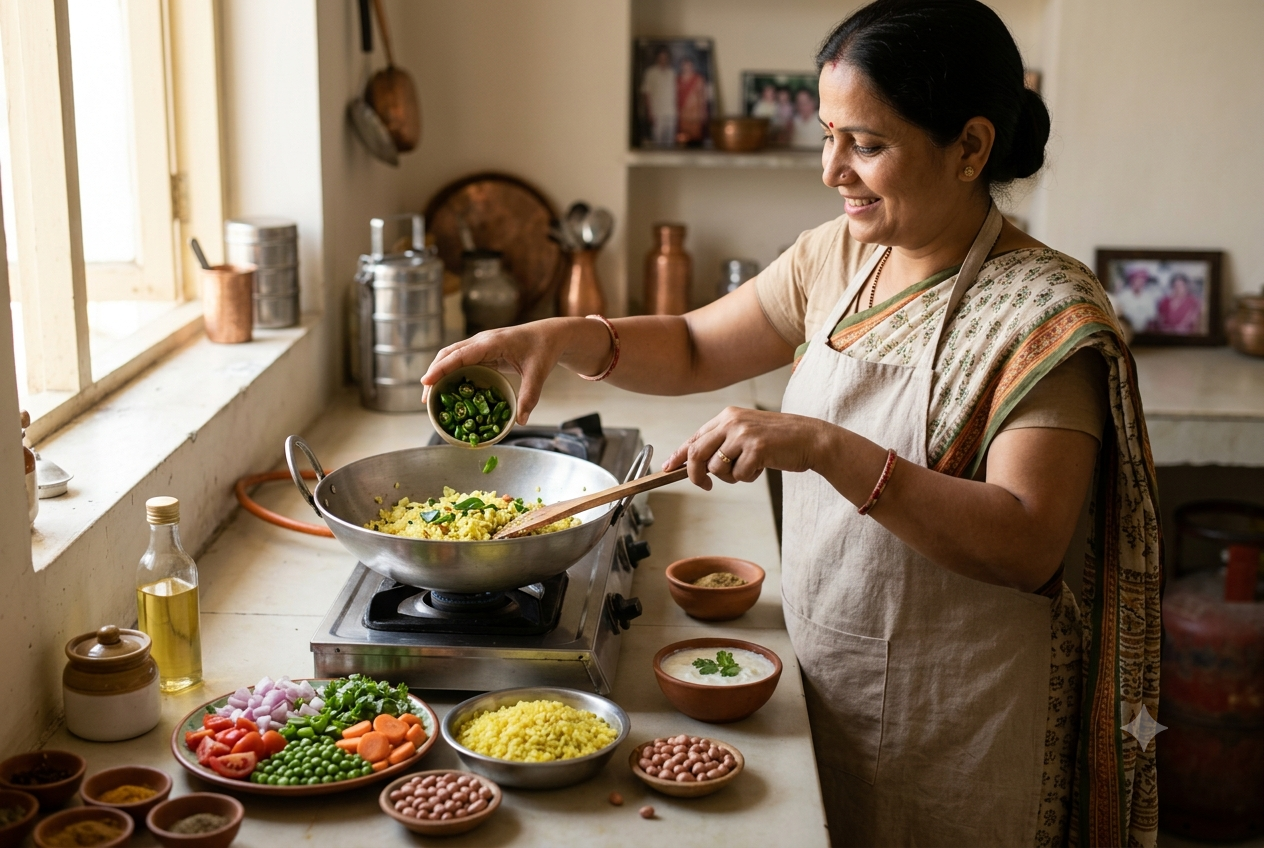
For example, when preparing vegetable poha at home, you can decide:
- How much oil to use
- How much salt to add
- Which vegetables to include
- Whether to add peanuts or another protein source
- How large the serving should be
You can also adjust recipes according to your family's preferences and dietary requirements.
This flexibility can make home cooking useful for creating varied meals based on vegetables, fruits, pulses, whole grains, nuts, dairy, eggs or other foods that suit your dietary pattern.
WHO identifies variety, adequacy, balance, moderation and diversity as important principles of a healthy diet.
But Homemade Doesn't Automatically Mean Healthy
It's easy to assume that anything cooked at home must be nutritious.
That's not always true.
Consider two homemade meals:
Meal A: Vegetable dal, brown rice, salad and curd.
Meal B: Deep-fried snacks, a sugary dessert and a heavily salted preparation.
Both are homemade.
But their nutritional profiles can be very different.
The same applies to cooking ingredients.
A homemade cake is still a cake. Homemade fried food is still fried food.
So instead of asking:
“Is it homemade?”
a better question is:
“What ingredients are being used, how is it prepared, and how often am I eating it?”
What About Packaged Food?
Packaged food covers a very large range of products.
It includes everything from relatively simple foods to highly processed snacks and ready-to-eat meals.
For example:
- Plain oats
- Whole-grain bread
- Frozen vegetables
- Unsalted nuts
- Canned beans
- Packaged curd
- Breakfast cereals
- Biscuits
- Instant noodles
- Chips
- Packaged desserts
- Ready-to-eat meals
Putting all of these foods into one category isn't particularly helpful.
Some packaged foods can provide useful nutrients and convenience, while others may contain substantial amounts of salt, free sugars or unhealthy fats.
WHO notes that diets containing significant amounts of highly processed foods are often associated with higher amounts of sodium, sugar or unhealthy fats.
This is why reading the label matters.
Learn to Read the Nutrition Label
When buying packaged food, don't rely only on the front of the package.
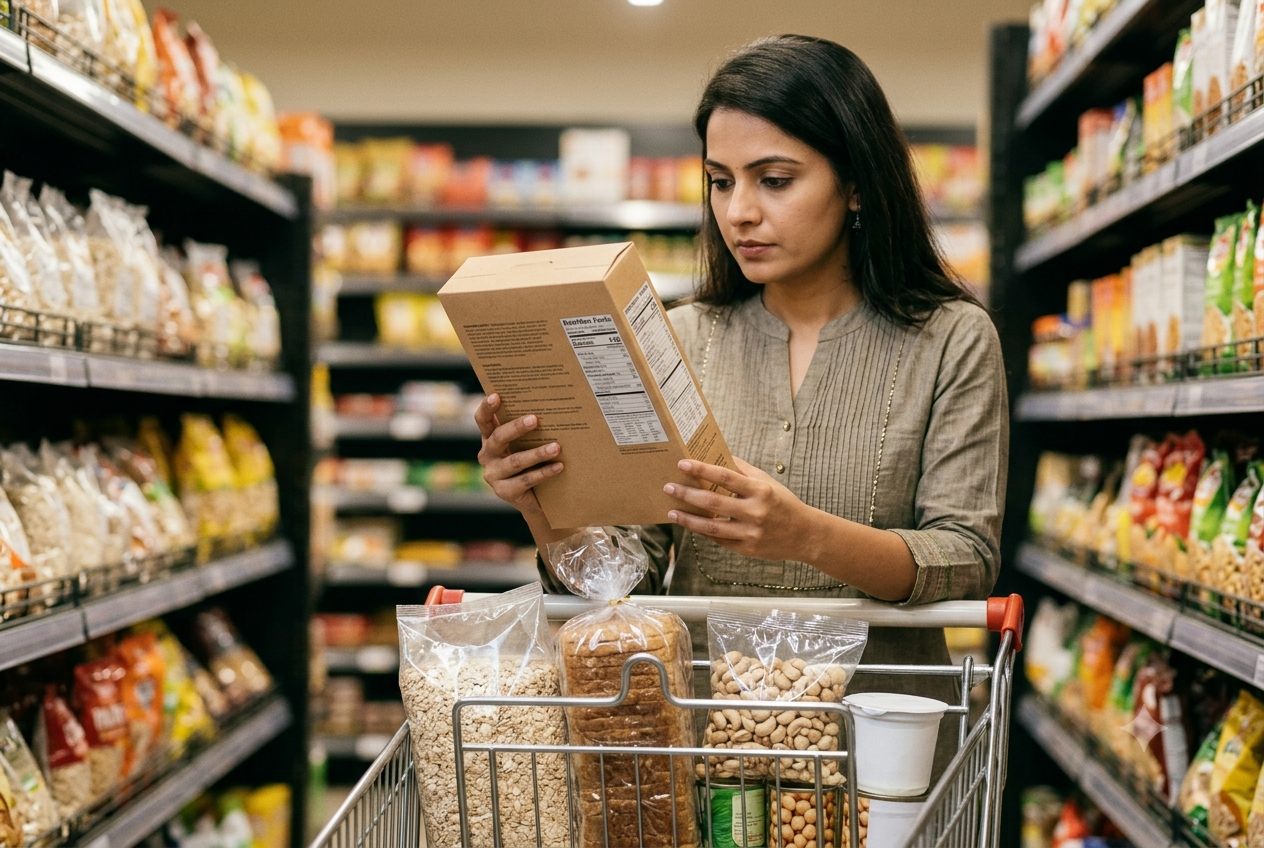
Turn it around and look at the nutrition information and ingredient list.
Depending on the product, pay attention to:
Serving size
A package may contain multiple servings.
If the nutrition information is provided per serving, eating the entire package may mean consuming considerably more than the listed amount.
Sugar
Look at the amount of sugar and consider how frequently you consume the product.
WHO recommends limiting free sugar intake as part of a healthy diet.
Sodium or salt
Many packaged foods can contribute significant amounts of sodium.
WHO recommends that adults consume less than 2 grams of sodium per day, equivalent to less than 5 grams of salt, although individual requirements can differ.
Fat
Look at total fat as well as saturated fat. Trans fat is another nutrient to pay attention to, particularly where relevant on the label.
Ingredient list
Ingredients are generally listed by quantity, with those used in greater amounts appearing earlier.
A quick look at the ingredient list can tell you much more about a product than attractive packaging alone.
Why Packaged Food Can Be Convenient
There is an important practical side to this discussion.
People have work, school, family responsibilities, travel and other commitments.
Preparing every meal entirely from scratch may not be realistic.
Packaged foods can provide convenience when time is limited.
For example, keeping frozen vegetables, plain oats, whole-grain bread or canned beans at home may make it easier to prepare a meal quickly.
The goal doesn't have to be:
“Never eat packaged food.”
Instead, it can be:
“Choose packaged foods thoughtfully and make minimally processed foods the foundation of most meals.”
WHO's current healthy-diet guidance similarly emphasizes a variety of minimally processed and unprocessed foods while recommending that foods high in unhealthy fats, free sugars and sodium be limited.
A Practical Approach for Indian Households
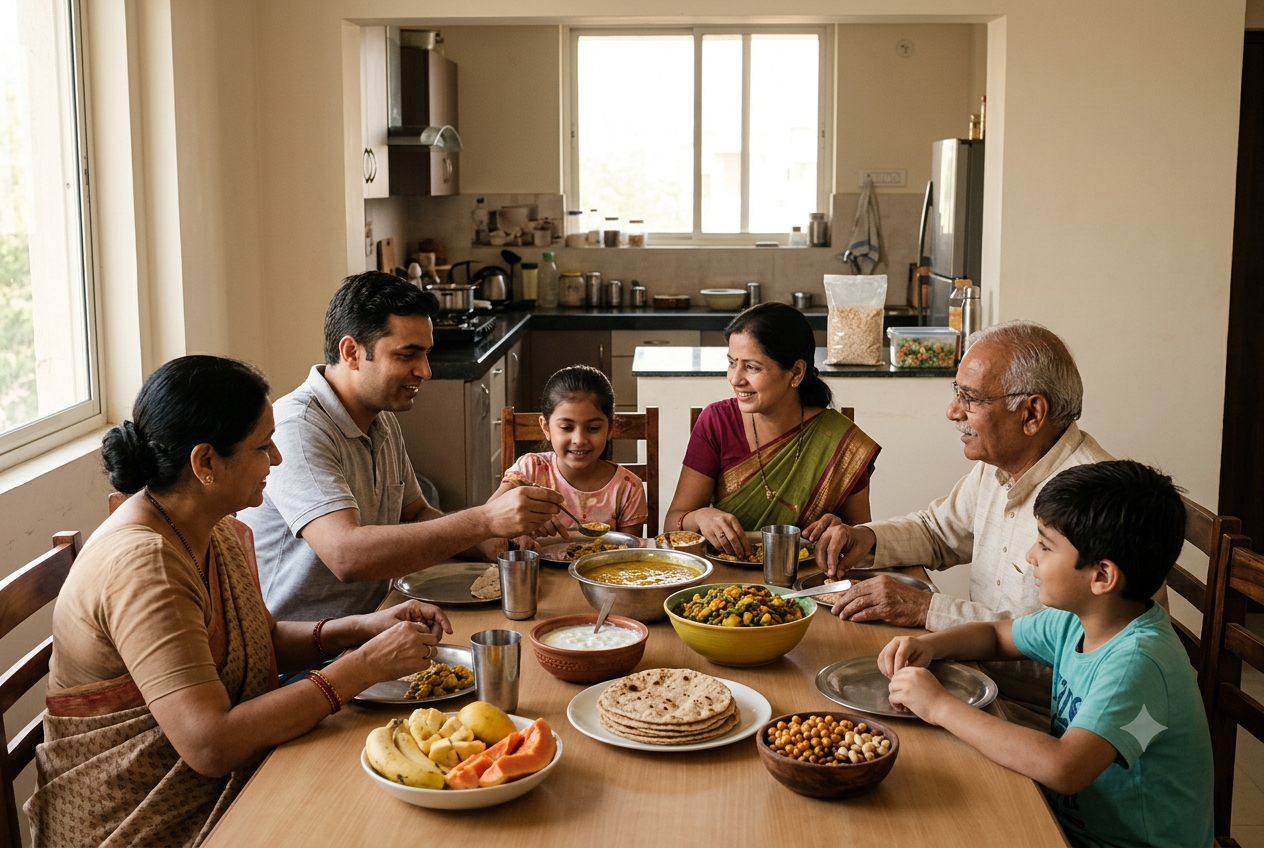
For many Indian families, a combination of homemade and packaged foods can work well.
For example:
Breakfast
Homemade: Vegetable poha + curd
Convenient alternative: Plain oats + fruit + nuts
Lunch
Homemade: Dal + roti + vegetables
Convenient alternative: Ready-to-use ingredients combined with freshly prepared vegetables or pulses
Snack
Homemade: Roasted chana or fruit
Packaged option: Unsalted or lightly salted nuts, depending on the product
Dinner
Homemade: Vegetable curry + dal + roti
The idea is not to eliminate convenience foods.
It is to build meals around foods that provide useful nutrients while keeping highly processed, salty, sugary or heavily fried options as occasional choices rather than the foundation of the diet.
Don't Ignore Portion Size
Even nutritious foods can contribute more energy than you need if portions are consistently large.
For example, nuts can be a nutritious food, but they are also energy-dense.
Similarly, homemade dishes can become heavy when large amounts of oil, butter, ghee or sugar are used.
Portion size therefore matters alongside food quality.
A balanced diet is not simply about identifying individual “good” and “bad” foods. It is about the overall pattern of what you eat.
Homemade Food Can Also Save Money
Cooking at home can sometimes be economical, particularly when meals are based on affordable staples such as:
- Rice
- Wheat
- Dal
- Beans
- Seasonal vegetables
- Fruits
- Curd
- Eggs
- Basic spices
However, homemade food isn't automatically cheaper.
Specialty ingredients, frequent food wastage or complicated recipes can increase costs.
Similarly, some packaged foods may be economical when purchased and used appropriately.
So cost should be considered alongside convenience, nutrition and food waste.
Food Safety Matters Too
Another important point is that homemade doesn't automatically mean safer.
Food needs to be handled, cooked and stored properly regardless of whether it is homemade or packaged.
Poor storage, cross-contamination or inadequate cooking can create food-safety risks.
Packaged foods also need proper storage and should be consumed according to their instructions and dates.
When buying packaged food, check the packaging condition and relevant date and storage information.
A Better Way to Think About the Choice
Instead of creating a strict rule such as:
“Homemade = good”
and
“Packaged = bad,”
consider asking five questions:
1. What is in the food?
Check the ingredients.
2. How much salt, sugar and fat does it contain?
Use the nutrition information where available.
3. How much am I eating?
Portion size matters.
4. How frequently am I eating it?
An occasional snack is different from eating the same highly processed product several times every day.
5. Does it fit into my overall diet?
One food rarely defines your entire eating pattern.
The 80/20 Idea Doesn't Need to Be a Rule
You may have heard people recommend eating “80% healthy food and 20% treats.”
While such simple rules can be motivating for some people, there is no universal percentage that applies to everyone.
Your nutritional needs depend on factors such as age, activity level, health status, dietary preferences and cultural context.
WHO similarly notes that the exact composition of a healthy diet varies according to individual characteristics and dietary customs.
So rather than following a rigid formula, focus on overall variety and balance.
Inkauras Insight
The real question isn't “homemade or packaged?”—it's “what is the food, how much am I eating, and how often?”
Homemade cooking can give you greater control over ingredients and preparation.
Packaged food can offer convenience and, depending on the product, can still contribute useful foods to your diet.
Learning to read labels, understanding portions and choosing a variety of foods can be more useful than completely avoiding one category.
Final Thought
Modern life doesn't always allow us to prepare every meal from scratch.
And that's okay.
A healthy eating pattern doesn't have to be perfect or complicated.
Cook at home when you can. Choose fresh or minimally processed foods regularly. Use packaged foods when they make life easier but check the label and understand what you're buying.
Most importantly, look at your overall eating pattern rather than judging individual foods in isolation.
Food should nourish you, fit your lifestyle and remain enjoyable.
The goal isn't perfection.
It's making better-informed choices more often.
Important Note
This article is provided for general educational and informational purposes only. It is not personalized nutrition, medical or dietary advice.
Individual nutritional needs vary depending on factors such as age, activity level, health conditions, allergies, medications, pregnancy and other circumstances. Anyone with a medical condition or specific dietary requirement should consult a qualified doctor or registered dietician before making significant dietary changes.
Food labels, formulations and regulations may also change over time. Readers should refer to the current product packaging and applicable official guidance when making purchasing or dietary decisions.
Share your thought, recipes to help & encourage others.
Rate this article
Sign in to rate this article.