
How Chatbots Understand What We Ask
While AI chatbots converse so naturally that they seem to possess human understanding, their responses actually stem from statistical pattern recognition and machine learning. Understanding how they process language and context helps you craft better prompts, avoid common misunderstandings, and use them productively without assuming every output is accurate.
Deepak Singhal
Introduction
Have you ever asked a Chatbot a question in everyday language and received an answer that seemed surprisingly relevant? You might ask it to explain a difficult topic, rewrite an email, suggest a meal plan or help troubleshoot a technical problem. Instead of requiring special commands, many modern Chatbots can respond to ordinary sentences and follow parts of a conversation.
This can make it seem as though a Chatbot understands language in the same way a person does. However, the process behind its responses is different from human understanding.
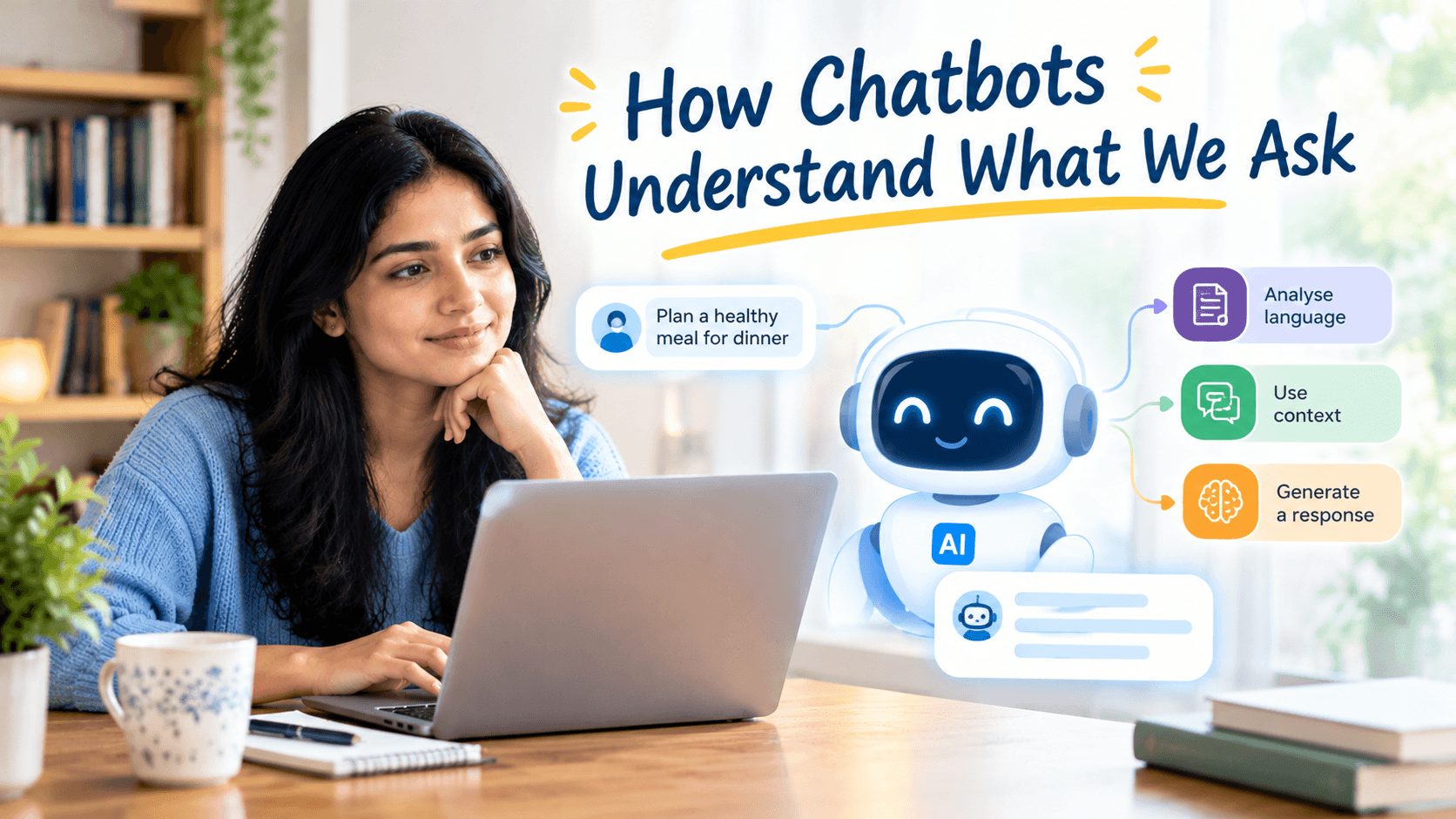
AI Chatbots use techniques from natural language processing and machine learning to analyze the text we provide, identify patterns, use available context and generate a response. Some systems also connect to external tools or information sources to perform specific tasks.
Understanding how this works can help us use Chatbots more effectively without assuming that every answer is correct. This article explains the basic process, how context influences responses, why Chatbots sometimes misunderstand questions and how to ask better questions.
1. What Happens When You Ask a Chatbot a Question?
When you type a question, the Chatbot does not simply look for an exact sentence in a list of stored answers. Modern AI Chatbots often process the input using a trained language model that has learned statistical patterns from large amounts of text and other data, depending on the system.
A simplified process involves several stages:
- Input processing: The system receives your message and converts it into a form its model can process.
- Language analysis: It uses learned patterns to interpret the words, relationships between them and possible meanings.
- Context consideration: It may use earlier messages in the conversation to understand what you are referring to.
- Response generation: The model generates a reply based on the input, available context and patterns learned during training.
- Additional processing: Depending on the Chatbot, other systems may check the response, retrieve information or use tools.
These stages are a simplified explanation, not a universal technical sequence. Different Chatbots use different architectures and supporting systems.
The important idea is that a Chatbot's response is generated through computation rather than through human-like awareness.

2. How Chatbots Process Human Language
A major technology behind conversational AI is natural language processing (NLP), a field concerned with enabling computers to process and work with human language.
People rarely communicate in perfectly structured sentences. We use abbreviations, incomplete questions, spelling mistakes, slang and words with multiple meanings. NLP techniques help systems process these variations.
For example, consider these questions:
- “How do I make my phone faster?”
- “My phone has become very slow. What can I do?”
- “Why is my mobile lagging?”
The wording differs, but the underlying concern is similar. A capable Chatbot may recognize that all three questions relate to phone performance.
Modern language models commonly use a process called tokenization, which breaks text into smaller units called tokens. Depending on the model, a token may represent a word, part of a word, punctuation or another text unit.
The model processes these tokens and their relationships to generate a relevant continuation. This helps it handle language patterns that are more flexible than simple keyword matching.
However, identifying a likely meaning does not guarantee that the system has interpreted the user's intention correctly. Ambiguous or incomplete questions can still produce misleading responses.
3. How Chatbots Use Context to Understand Follow-Up Questions
Imagine asking a Chatbot, “What are the benefits of walking every day?” After receiving an answer, you ask, “What about older adults?”
A basic keyword-based system might struggle to connect the second question with the first. A conversational AI Chatbot may use the previous exchange to infer that you are asking about the benefits of walking for older adults.
This ability depends on conversation context. The system can use earlier messages that remain available within its current context to interpret references such as “it,” “that option” or “tell me more.”
However, context has limits. A Chatbot may lose track of details in a long conversation, misunderstand an unclear reference or lack access to an earlier chat. Some systems also use saved preferences or other information when explicitly supported by their features and settings.
For better results, briefly restate important details when changing topics or returning to an earlier discussion. Do not assume every Chatbot remembers everything you have said.

4. How Chatbots Learn to Respond
Many modern conversational Chatbots use large language models (LLMs). During training, these models learn statistical patterns and relationships from large datasets. They adjust internal parameters to improve their ability to predict and generate language.
For example, after learning from many examples of explanations, questions and conversations, a model may become capable of producing a clear explanation of a familiar subject.
Training and using a model are different processes. Training develops the model's capabilities; when you submit a question, the model uses what it has learned to generate a response. Some products may also use additional training, instructions, retrieval systems or tools to improve how they respond.
A Chatbot does not necessarily verify every statement against a reliable source before answering. Its ability to produce convincing language should not be confused with guaranteed factual accuracy.
5. Why Chatbots Sometimes Get Questions Wrong
Chatbots can misunderstand questions or provide inaccurate information, even when their answers sound confident.
Common reasons include:
- Ambiguous wording: A question may have several possible meanings.
- Missing context: The user may leave out a detail that changes the answer.
- Knowledge limitations: The model may not know about a recent event or a specific source.
- Incorrect generation: The model may produce a plausible sounding but unsupported statement.
- Unreliable inputs: If supplied information is incomplete or incorrect, the response may reflect those problems.
Some generative AI systems produce what are commonly called hallucinations: statements that appear credible but are false or unsupported. NIST identifies confabulation and other reliability concerns among the risks associated with generative AI.
For example, a Chatbot might invent a book title, misquote a statistic or give an outdated answer about a software feature. These limitations are particularly important when dealing with medical, legal, financial or other high-impact decisions.

6. How to Ask Better Questions
You can often improve a Chatbot's response by making your request more specific.
Instead of asking, “Explain AI,” try: “Explain artificial intelligence in simple language for a beginner, using three everyday examples.”
Useful practices include:
- State your goal: Explain what you want to achieve.
- Provide relevant context: Mention your audience, situation or constraints.
- Specify the format: Ask for a checklist, comparison, short explanation or step-by-step guide.
- Set boundaries: Mention the level of detail or type of information you need.
- Ask for uncertainty: Request that the Chatbot identify assumptions and distinguish verified facts from uncertain claims.
- Verify important details: Check reliable sources instead of treating the answer as automatically correct.
These techniques help clarify the task, although they cannot guarantee an accurate answer.
Inkauras Insight
Chatbots appear to understand us because they can recognize language patterns, use available context and generate responses that fit our requests. Their capabilities can be useful, but fluent conversation is not proof of human-like understanding or factual reliability.
The most effective approach is to treat a Chatbot as a tool for assistance, exploration and drafting—not as an unquestionable authority.
Final Thought
AI chatbots are changing how people search for information, learn new concepts and complete everyday tasks. Understanding how they process language makes it easier to use them thoughtfully.
Ask clear questions, provide useful context and verify important claims. With these habits, you can benefit from conversational AI while remaining aware of its limitations.
Disclaimer
This article is for general educational and informational purposes only. AI technologies differ in their design, capabilities and limitations, and their behavior can change as products are updated. This article is not professional technical, legal, medical or financial advice. Verify important information using reliable sources and qualified professionals where appropriate.
Share your views in the comment section.
Rate this article
Sign in to rate this article.