
How Parents Can Encourage Children to Learn
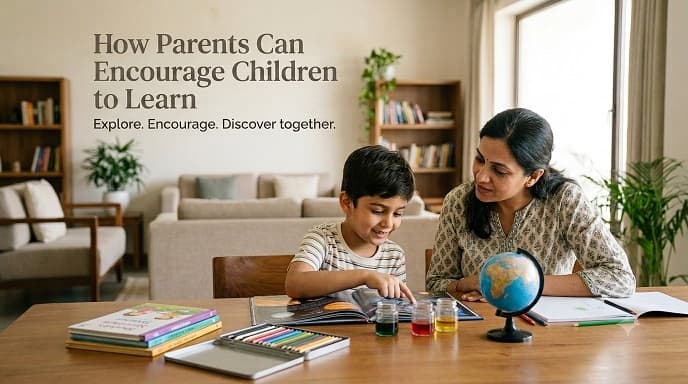
Encouraging a child to learn doesn't require endless textbook sessions or pressure over grades, but rather nurturing their natural curiosity through everyday conversations and shared experiences. By providing supportive, responsive environments, parents can help children view learning as a meaningful, lifelong journey rather than a chore.
InkAuras
Introduction
Children are naturally curious. They ask questions, explore their surroundings, imitate adults and want to understand how things work. Yet as children grow, learning can sometimes become associated mainly with homework, tests, grades and academic expectations.
Parents can play an important role in shaping a child's attitude toward learning—but encouraging children to learn does not necessarily mean sitting beside them for hours with textbooks or constantly reminding them to study.
In many cases, small everyday habits can make learning feel more interesting and meaningful.
A conversation during dinner, a visit to a museum, reading a story together, allowing a child to try something independently or simply asking, “What did you discover today?” can turn ordinary moments into learning opportunities.
Research and guidance from organizations such as the UNICEF and Harvard Center on the Developing Child emphasize the importance of supportive relationships, responsive interactions and environments that help children develop and learn.
The goal is not to make every moment educational.
It is to help children develop a healthy relationship with curiosity, effort and learning.
1. Make Curiosity Feel Welcome
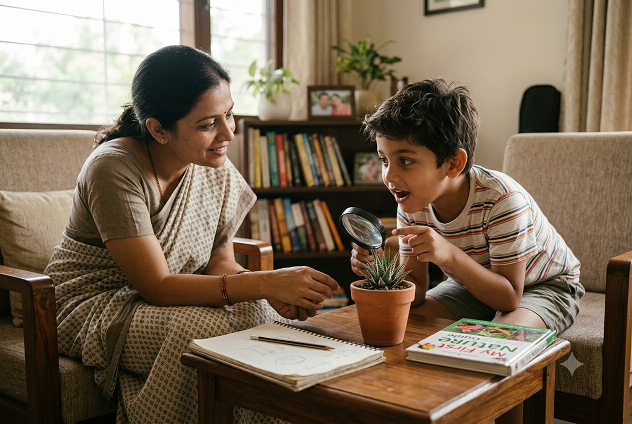
One of the simplest ways parents can encourage learning is by taking children's questions seriously.
Children may ask questions that seem obvious or repetitive:
- Why is the sky blue?
- How does a plant grow?
- Why do we need sleep?
- Where does rain come from?
- How does a phone know where we are?
Instead of immediately giving the answer, parents can sometimes respond with another question:
“What do you think?”
This encourages children to think before looking for an answer.
You don't need to know everything yourself. Saying “I'm not sure—let's find out together” can also demonstrate that learning continues throughout life.
This approach can help children see questions as opportunities rather than something they should be embarrassed to ask.
2. Focus on Effort, Not Just Results
Children often receive attention when they get something right.
However, learning also involves mistakes, confusion and repeated attempts.
If a child struggles with a mathematics problem, for example, saying “You're very smart” may feel encouraging, but it doesn't necessarily tell the child what helped them succeed.
A more useful response might be:
“You tried a different approach and kept working on it.”
The emphasis is on the process.
Parents can acknowledge:
- Persistence
- Careful thinking
- Practice
- Problem-solving
- Asking for help
- Trying a new approach
This doesn't mean avoiding praise for achievement. Rather, it helps children understand that progress usually comes through effort and practice.
The American Academy of Pediatrics similarly encourages parents to support children's development through positive interactions and realistic expectations rather than relying only on performance outcomes.
3. Create a Comfortable Learning Environment
Children don't necessarily need an expensive study room to learn effectively.
A reasonably quiet, organized space with appropriate lighting, basic stationery and access to books can be enough for many everyday learning activities.
Depending on the child's age, parents might provide:
- Storybooks
- Drawing materials
- Puzzles
- Building blocks
- Educational games
- Simple science materials
- Age-appropriate reference books
The environment should be practical rather than perfect.
It is also useful to reduce unnecessary distractions during focused study time. Constant notifications, television or unrelated devices can make concentration more difficult.
At the same time, children shouldn't be expected to remain focused for unrealistic periods.
Short, age-appropriate periods of focused activity followed by breaks can be more practical.
4. Read Together Regularly
Reading is one of the simplest habits families can build.
For younger children, parents can read stories aloud.
Older children can read independently and discuss what they have read afterward.
Reading together doesn't always have to involve academic books.
Children can explore:
- Fiction
- Comics
- Children's magazines
- Biographies
- Nature books
- History
- Age-appropriate science
- Travel stories
The objective is to help children discover that reading can provide information and enjoyment.
Parents can also ask simple questions:
“Which character did you like?”
“What would you have done?”
“Why do you think that happened?”
These conversations can turn reading into an active experience rather than a passive task.
5. Connect Learning With Everyday Life
Children often understand ideas more easily when they can connect them to something familiar.
Mathematics can appear while shopping.
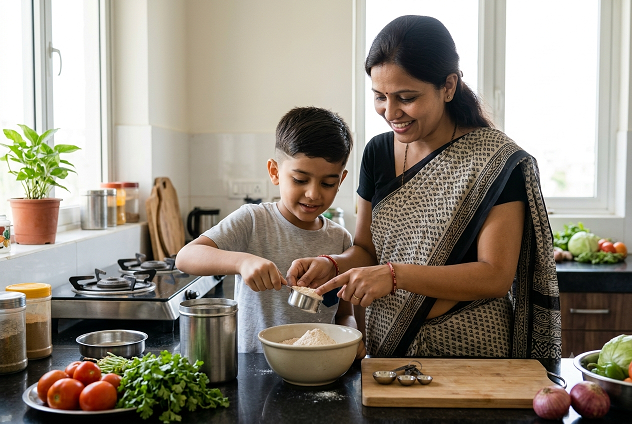
Science can appear while cooking.
Geography can appear while planning a trip.
Writing can appear while creating a shopping list.
History can come alive while visiting a historical place.
For example, when preparing a meal, parents might discuss measurements, ingredients, temperature or how different foods change during cooking.
These aren't formal lessons.
They are opportunities to show children that learning exists beyond the classroom.
6. Let Children Explore Their Interests
Every child may not be interested in the same subjects.
One child may love animals. Another may enjoy drawing. Someone else may become fascinated by machines, stories, sports or space.
Parents can use these interests as starting points for broader learning.
Suppose a child becomes interested in dinosaurs.
That interest can lead naturally to questions about:
- Fossils
- Earth history
- Geography
- Biology
- Scientific discovery
- Museums
- Research
The child's curiosity becomes the doorway.
Parents don't need to turn every interest into an academic assignment.
Sometimes simply allowing children to explore something deeply can be valuable.
7. Give Children Opportunities to Solve Problems
Parents naturally want to help when children face difficulties.
But solving every problem for them can reduce opportunities to practice independent thinking.
When appropriate, try asking:
“What could you try first?”
or
“Can you think of another way?”
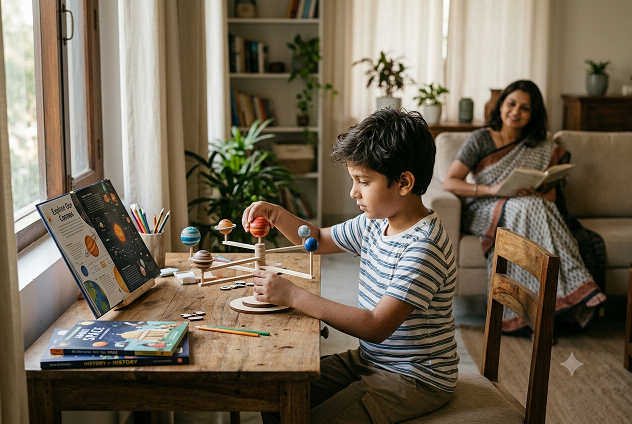
This gives the child space to experiment.
For example, if a child cannot assemble a toy, instead of immediately doing it for them, a parent might encourage them to look at the instructions, examine the pieces and try another arrangement.
The goal isn't to make children struggle unnecessarily.
It's to provide enough support without removing every challenge.
This balance is sometimes described as providing scaffolding—help that supports a child while they develop greater independence.
8. Avoid Comparing Children With Others
Comparison can easily turn learning into competition.
Statements such as:
“Your friend gets better marks than you.”
or
“Why can't you study like your brother?”
may create pressure rather than genuine curiosity.
Children develop at different rates and may have different strengths.
A more constructive approach is to compare the child with their own previous efforts.
Instead of:
“Why did you score less than her?”
try:
“Which part was difficult this time, and what can we work on next?”
This shifts attention from competition toward improvement.
9. Teach Children That Mistakes Are Part of Learning
A mistake doesn't necessarily mean a child isn't capable.
Sometimes it simply shows that something hasn't been understood yet.
Parents can model this attitude themselves.
If you make a mistake while cooking, assembling something or using technology, you can say:
“That didn't work. Let's see what we can change.”
Children observe how adults react to mistakes.
If adults treat mistakes as disasters, children may become afraid of making them.
If adults treat mistakes as information, children may become more comfortable experimenting and trying again.
Of course, repeated mistakes may sometimes indicate that a child needs additional explanation or support. Encouragement should therefore be combined with appropriate guidance.
10. Ask Questions Instead of Giving Constant Instructions
Parents sometimes become the child's permanent reminder system:
“Do your homework.”
“Read your book.”
“Study now.”
“Have you finished?”
Some reminders are necessary, particularly for younger children.
But over time, parents can gradually encourage children to take more responsibility.
Questions can help:
- “What's your plan for finishing this?”
- “Which task should you do first?”
- “Do you need any help?”
- “What will you revise today?”
This gives children an opportunity to practice planning and self-management.
The level of independence should naturally depend on the child's age and maturity.
11. Use Technology Thoughtfully
Technology can provide children with access to educational videos, digital libraries, interactive tools and creative applications.
But technology itself doesn't automatically make learning better.
The quality of the activity matters.
Parents can ask:
“What are you learning from this?”
They can also encourage children to create rather than only consume.
For example, a child might:
- Create a presentation
- Make a digital drawing
- Record a short explanation
- Build a simple project
- Research a topic
- Write a story
Parents should also consider age-appropriate safety, privacy, screen-time and content considerations.
The American Academy of Pediatrics provides guidance for families on creating healthy media habits appropriate to children's developmental needs.
12. Protect Time for Sleep, Play and Physical Activity
Learning isn't only about sitting at a desk.
Children also need adequate sleep, physical activity, play and opportunities for social interaction.
These activities are part of healthy development and can support a child's ability to participate in learning.
The World Health Organization provides age-specific recommendations covering physical activity, sedentary behavior and sleep for children and adolescents.
This is an important reminder for parents:
A productive childhood doesn't mean a completely scheduled childhood.
Free play and downtime also have value.
Children need opportunities to explore without every minute being structured by adults.
13. Be a Learning Role Model
Children notice what adults do.
If parents regularly read, ask questions, learn new skills or admit that they don't know something, children receive a powerful message:
Learning isn't something that ends when school ends.
Parents don't have to become teachers at home.
Simply demonstrating curiosity can help.
You might learn a recipe, read about a historical event, repair something, learn a language or explore a new technology.
Let your child see that adults also make mistakes, ask questions and learn.
14. Know When Extra Support May Be Needed
Encouragement can make a meaningful difference, but parents shouldn't assume that every learning difficulty can be solved through motivation or better study habits.
If a child consistently struggles with reading, writing, attention, communication, memory or particular academic skills, it may be appropriate to discuss the situation with the child's teacher or a qualified professional.
Early conversations can help identify whether additional educational support or assessment may be appropriate.
Importantly, struggling in one area does not mean a child lacks intelligence.
Children can have different learning strengths and may need different forms of support.
A Simple Daily Approach for Parents
Parents don't need to redesign their entire family routine.
A simple approach could look like this:
10 minutes: Read together or discuss something interesting.
5 minutes: Ask the child what they learned or wondered about that day.
Everyday activity: Connect one ordinary task with a learning opportunity.
Independent time: Let the child explore an interest without constant instruction.
Evening: Talk about one thing that was difficult and what they could try next time.
The exact routine isn't important.
Consistency and a supportive environment matter more than creating a perfect schedule.
Inkauras Insight
Encouraging children to learn is not about turning parents into teachers.
It is about creating an environment where children feel comfortable being curious, making mistakes, asking questions and trying again.
Parents can support this by listening to questions, recognizing effort, encouraging independence, reading together and connecting everyday experiences with learning.
Most importantly, children don't need parents who know every answer.
They benefit from adults who are willing to say:
“I don't know. Let's find out together.”
That simple sentence can turn a question into an opportunity for discovery.
Final Thought
Children don't learn only when they are sitting in a classroom.
They learn while playing, talking, reading, experimenting, observing and asking questions.
Parents can encourage this natural process by making learning feel less like a constant demand and more like a normal part of everyday life.
The goal isn't to create perfect students.
It is to help children gradually become curious, confident and independent learners.
A child who learns to enjoy discovering something new may carry that habit far beyond school.
Important Disclaimer
This article is provided for general educational and informational purposes only. It is not a substitute for individualized educational, psychological, developmental, medical or professional advice.
Children develop at different rates, and strategies that work well for one child may not work equally well for another. Parents who have ongoing concerns about a child's learning, development, behavior, communication or academic progress should consider discussing those concerns with the child's teacher, school or an appropriately qualified professional.
Any references to child development or learning research are intended to provide general context and should not be interpreted as a diagnosis or individualized recommendation.Rate this article
Sign in to rate this article.