
How Smartphones Have Changed Our Daily Lives
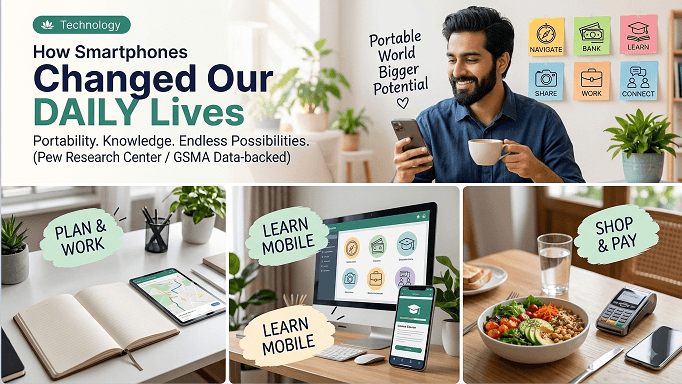
Smartphones have evolved far beyond communication tools, becoming essential hubs for work, learning, entertainment, and daily management. While they offer unprecedented convenience and access to services, they have also fundamentally reshaped our attention, communication habits, and daily interactions.
Deepak Singhal
Introduction
Think about how you started your day today.
Perhaps your phone woke you up. You checked the weather, read a few messages, looked at the news, checked your email and maybe opened social media—all before getting out of bed.
Later, the same device may help you find your route, pay a bill, attend a meeting, order food, learn something new, take photographs or speak with someone hundreds of kilometres away.
The smartphone has gradually become much more than a device for making calls.
It has become a portable tool for communication, information, work, entertainment, learning and everyday problem-solving.
The GSMA reports that smartphones and mobile internet are now central to how people access digital services, while its 2026 Mobile Economy report describes mobile technology as an increasingly important part of economic and social life.
But this transformation isn't entirely about convenience. Smartphones have also changed how we spend our attention, communicate with others and interact with the world around us.
So, how exactly have smartphones changed our daily lives?
1. Communication Has Become Instant
One of the biggest changes is how easily we can communicate.
A traditional phone was primarily used for voice conversations. Smartphones have expanded that into messaging, video calls, email, social media and countless communication apps.
You can send a photograph to your family, join a video meeting with colleagues, or speak with a friend living in another country within seconds.
Research from Pew Research Center has consistently found that mobile phones play an important role in helping people stay connected. In one international study, a median of 93% of respondents across 11 countries said their mobile phone had mostly helped them keep in touch with people living far away.
The result is a world where distance is often less of a barrier to everyday communication.
2. Information Is Always Within Reach
Before smartphones became common, finding information often meant using a computer, visiting a library or asking someone who knew the answer.
Today, many questions can be answered within seconds.
Where is the nearest pharmacy?
What does this word mean?
How will the weather change tomorrow?
How do I fix this household problem?
What is happening in the news?
A smartphone can provide access to search engines, websites, digital libraries, maps, videos and educational platforms from almost anywhere with connectivity.
Pew Research Center found that smartphone users turn to their phones for information about health, education, jobs, government services and other important areas of life.
This convenience has changed our expectations. We increasingly expect useful information to be available immediately.
3. Work Has Become More Mobile
Smartphones have also changed the workplace.
Email, messaging platforms, calendars, video meetings, cloud services and collaboration applications can allow people to handle certain work tasks without being physically present at a desk.
This can be particularly useful for people who travel frequently or work across different locations.
A person may check an urgent email at an airport, approve a document while travelling or join a meeting from another city.
Mobile technology has also contributed to broader changes in the digital economy. GSMA reports that mobile technologies and services generated an estimated $7.6 trillion in economic value in 2025, representing 6.4% of global GDP.
However, being able to work anywhere doesn't necessarily mean we should work everywhere.
Constant connectivity can make it harder for some people to create a clear boundary between professional and personal time.
That is why using smartphone technology intentionally can be just as important as having access to it.
4. Navigation Has Become Easier
Remember when getting lost meant stopping to ask for directions?
Smartphones have dramatically changed navigation.
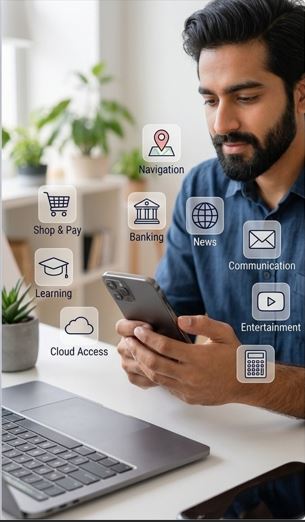
GPS, digital maps and location services allow people to:
- Find unfamiliar places
- Plan routes
- Check traffic conditions
- Locate restaurants and shops
- Estimate travel times
- Discover nearby services
- Share their location with others
This has made travelling through unfamiliar areas much easier.
For many people, the smartphone has effectively replaced the separate map, GPS device and printed directions they might once have carried.
5. Banking and Payments Have Moved to the Phone
Smartphones have also changed how people manage money.
Mobile banking apps can allow users to check balances, transfer money, pay bills and monitor transactions without visiting a bank branch.
Mobile payment systems have also made it possible to make purchases using a phone in many markets.
Pew Research Center's research has shown that smartphone users already use their devices for financial activities such as online banking.
This convenience can save time, but it also makes digital security increasingly important.
Strong passwords, device locks, software updates, two-factor authentication and caution with suspicious links are sensible habits for smartphone users.
6. Learning Is No Longer Limited to the Classroom
A smartphone can also become a small learning device.
You can listen to a language lesson while travelling, watch a tutorial, read an article or take an online course.
Students can access educational resources, while working professionals can learn new skills outside traditional classrooms.
Pew Research Center found that smartphone owners use their phones to access educational content and information related to work and learning.
This doesn't mean smartphones replace teachers, books or structured education.
Instead, they provide another way to access knowledge when and where it is convenient.
7. Entertainment Has Become Personal
Music, movies, podcasts, games, photographs and social media can all fit inside one device.
Entertainment has therefore become more portable and personalised.
Instead of waiting to reach home to watch a programme or listen to music, people can access content while travelling or during breaks.
The advantage is convenience.
The challenge is that entertainment is always available too.
When there is a spare moment, it can be tempting to immediately reach for the phone.
Over time, this can change how we experience boredom, waiting and quiet moments.
8. Smartphones Have Changed How We Capture Memories
Photography has become one of the most everyday smartphone activities.
Instead of carrying a separate camera, most people can simply take their phone out of their pocket.
Birthdays, family gatherings, holidays, meals, sunsets and everyday moments can all be captured instantly.
Smartphone cameras have also made photography more accessible to people who may never have owned a dedicated camera.
But there is an interesting side effect.
Sometimes we can become so focused on capturing a moment that we forget to experience it.
A useful balance may be to take the photograph—and then put the phone away for a while.
9. Everyday Tasks Have Become More Convenient
Perhaps the biggest change isn't one particular feature.
It's the fact that a single device can handle dozens of small everyday tasks.
A smartphone can act as:
- Alarm clock
- Calendar
- Calculator
- Camera
- Compass
- Flashlight
- Music player
- Map
- Scanner
- Notebook
- Payment device
- Communication tool
This consolidation is one reason smartphones have become so deeply integrated into daily routines.
GSMA notes that mobile technology increasingly supports access to services and participation in the digital economy, while also highlighting the importance of addressing affordability, digital skills and safety.
10. Smartphones Have Also Changed Our Attention
The smartphone story isn't only positive.
Because so many activities are concentrated in one device, notifications can constantly compete for our attention.
A message arrives.
Then an email.
Then a social media notification.
Then a news alert.
Then another message.
The result can be a habit of checking the phone repeatedly—even when there isn't anything particularly important to see.
Research on mobile phone use has found that people use their devices for many different purposes, including coordinating with others, avoiding boredom and managing reminders and everyday logistics.
This doesn't mean smartphones are inherently harmful.
It means how we use them matters.
The Smartphone Balance: Convenience vs. Dependence
Smartphones can make life easier without necessarily needing to become the centre of our lives.
A useful approach is to ask:
Is my smartphone helping me accomplish something, or am I using it simply because I have a spare moment?
Some simple habits can help:
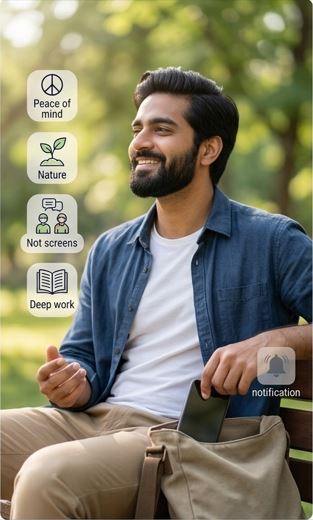
Turn off unnecessary notifications
Not every application needs permission to interrupt you.
Create phone-free periods
Meals, conversations or the first few minutes after waking up can be opportunities to stay away from the screen.
Review your app usage
Understanding where your time goes can help you decide whether anything needs changing.
Keep important accounts secure
Use strong authentication and avoid suspicious links or downloads.
Make technology serve your priorities
Use navigation, banking, learning, communication and other tools when they provide genuine value.
The goal isn't to reject technology.
The goal is to use it deliberately.
What the Future May Look Like
Smartphones are continuing to evolve.
Artificial intelligence, faster mobile networks, improved cameras, digital payments, health-related features and connected devices are expanding what phones can do.
GSMA's 2026 industry outlook highlights the continued development of 5G, AI and other digital technologies across the mobile ecosystem.
The smartphone of the future may therefore become even more integrated into everyday activities.
But the most important question may not be “What can our phones do next?”
It may be:
“How should we use these capabilities without allowing technology to control our attention?”
Inkauras Insight
The smartphone is one of the clearest examples of how technology can quietly transform everyday life.
It started primarily as a communication device.
Today, it can help us communicate, work, learn, travel, shop, manage finances, access information and entertain ourselves.
That transformation has brought enormous convenience.
But convenience works best when we remain in control of how we use it.
A smartphone is a powerful tool. The important thing is to make sure it remains a tool—not a constant interruption.

Final Thoughts
Smartphones have changed daily life in ways that would have seemed extraordinary just a few decades ago.
They have reduced the effort required to communicate, find information, navigate unfamiliar places, manage money and access services.
They have also created new challenges around attention, privacy, security and digital habits.
There is no need to view smartphones as either completely good or completely bad.
The more useful approach is to understand both sides.
Use the convenience. Protect your attention. Stay aware of your digital habits.
Technology should make life easier—but our lives should still exist beyond the screen.
Technology Disclaimer
This article is intended for general informational and educational purposes only. It is not professional advice relating to cybersecurity, finance, healthcare, mental health, telecommunications or any other specialized field.
Technology features, services, security practices, availability and product capabilities can change over time. Readers should verify important information with the relevant service provider or qualified professional before making decisions that depend on it.Rate this article
Sign in to rate this article.