
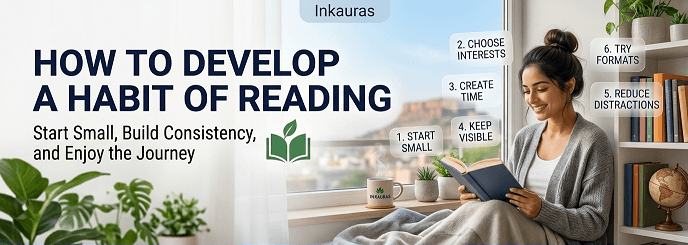
How to Develop a Habit of Reading
Despite strong interest, daily distractions often push reading aside, leaving books untouched. Developing a lasting reading habit isn't about powering through hours of pages; it relies on building simple, consistent routines that seamlessly integrate reading into your everyday life.
InkAuras
Introduction
Reading is one of those activities that many people want to do more often.
We may buy books, save articles, download e-books or create a list of titles we want to read. Yet after a few days, the book may remain untouched on the bedside table.
The problem is not always a lack of interest.
Modern routines are full of distractions. Smartphones, social media, streaming platforms, work, family responsibilities and daily commitments can easily push reading to the bottom of the list.
The good news is that becoming a regular reader doesn't necessarily require reading for hours every day.
A better approach is to make reading simple, enjoyable and consistent.
A reading habit develops through repeated behavior, particularly when that behavior is connected to a stable context or routine. Research on habits suggests that repetition in consistent situations can gradually make a behavior more automatic.
So, instead of asking "How many books should I finish this year?", it may be more useful to ask:
"How can I make reading a natural part of my day?"
1. Start With a Small Reading Goal
One of the biggest mistakes people make is starting too aggressively.
You may decide to read 50 pages every day, only to discover that your schedule doesn't allow it.
A smaller target is often easier to maintain.
Start with:
- 5–10 pages a day
- 10 minutes of reading
- One short article
- A few pages before bed
- One chapter on selected days
The purpose initially isn't to maximize the amount you read.
It is to build consistency.
Once reading becomes comfortable, you can gradually increase the amount if you want to.
2. Choose Books You Actually Want to Read
A reading habit becomes difficult when reading feels like homework.
You don't have to begin with a book that everyone says you should read.
Choose something that genuinely interests you.
You might enjoy:
- Fiction
- Biography
- History
- Business
- Science
- Technology
- Personal development
- Travel
- Psychology
- Current affairs
- Short stories
The right choice depends entirely on your interests.
If you're returning to reading after a long break, an engaging book that you actually want to pick up may be more useful than a highly challenging book that you continually avoid.
3. Create a Specific Reading Time
A common intention is:
"I'll read when I have free time."
The problem is that free time doesn't always appear.
Instead, connect reading with a specific part of your existing routine.
For example:
After breakfast → 10 minutes of reading
After dinner → 15 minutes of reading
Before bedtime → One chapter
During the daily commute → E-book or audiobook
Research on habit formation indicates that behaviors repeated in a stable context can become more habitual over time.
The important point isn't that there is one perfect time to read.
It's finding a time that fits your routine.
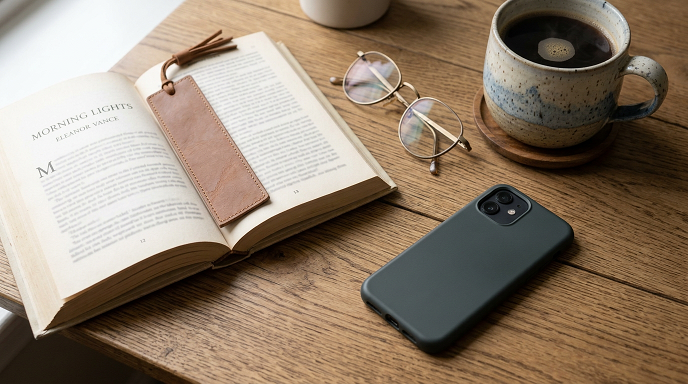
4. Keep Your Book Visible
Environment can influence behavior.
If your book is hidden inside a cupboard while your phone is sitting beside you, the phone will often be the easier option.
Try keeping your current book somewhere visible:
- Beside your bed
- On your desk
- In your work bag
- On a coffee table
- Next to your favorite chair
If you read digitally, keep your reading app or e-reader easily accessible.
The goal is to reduce the effort required to begin.
5. Reduce Digital Distractions
You don't necessarily have to eliminate technology to become a better reader.
But you may need to create some distance from distractions.
When reading:
- Put your phone on silent
- Turn off unnecessary notifications
- Use "Do Not Disturb" if appropriate
- Keep social media closed
- Choose a quieter environment
Even 15 minutes of uninterrupted reading can feel very different from trying to read while constantly checking notifications.
If you're reading on a phone or tablet, consider using a dedicated e-reader or adjusting the device so that other apps are less tempting.
6. Don't Force Yourself to Finish Every Book
There is no rule saying that every book you start must be completed.
Sometimes a book simply isn't right for you.
Perhaps the writing style doesn't work.
Perhaps the subject isn't as interesting as you expected.
Perhaps the book is too advanced for what you currently want.
That's okay.
You can put it aside and try something else.
The goal is to develop a sustainable relationship with reading, not to create a collection of unfinished guilt.
Of course, some books require patience and become more interesting later. The decision is yours.
7. Make Reading Comfortable
Your reading environment matters.
Find a place where you can comfortably sit for a while.
You might prefer:
- A comfortable chair
- A quiet corner
- A library
- A balcony
- A café
- Your bedside
Good lighting can also make reading more comfortable, particularly for longer sessions.
You don't need to create a perfect reading room.
A simple, comfortable space is enough.

8. Use Different Formats
Reading doesn't always have to mean holding a physical book.
Depending on your circumstances, you can explore:
Printed books: Useful if you enjoy the physical experience.
E-books: Convenient when you want to carry multiple books.
Audiobooks: Useful when you are walking, travelling or doing certain routine activities where listening is practical.
Digital articles: Helpful when you want shorter reading sessions.
Different formats can fit different parts of your life.
For example, you might read a physical book before bed and listen to an audiobook while travelling.
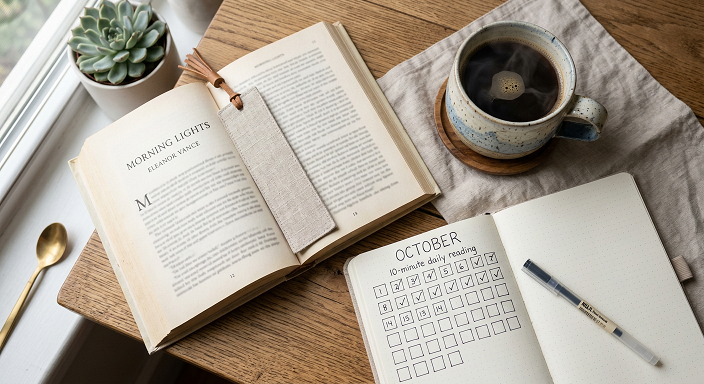
9. Keep Track of Your Progress Without Obsessing Over It
Tracking can provide motivation, but it shouldn't become another source of pressure.
You could simply maintain a list of books you've finished.
Or record:
- Book title
- Date started
- Date completed
- Favorite idea
- One thing you learned
A simple reading journal can make the experience more meaningful.
However, avoid turning reading into a competition.
Finishing ten books isn't automatically better than finishing three books that genuinely interested you.
Quality and enjoyment matter too.
10. Talk About What You Read
Reading becomes more engaging when you share ideas with others.
After finishing a book, consider discussing it with:
- Friends
- Family
- Colleagues
- A book club
- An online reading community
You could even write a short summary for yourself.
Ask:
What was the main idea?
What did I learn?
Did I agree with the author?
Would I recommend this book to someone else?
Thinking about what you've read can help turn reading from a passive activity into a more active learning experience.
11. Don't Worry About Missing a Day
This is particularly important when developing any new habit.
You may read every evening for a week and then miss two days because of work, travel or family commitments.
That doesn't mean the habit has failed.
Simply return to it.
Research into habit formation shows that behaviors develop differently for different people and circumstances; there isn't a universal timeline that applies to everyone.
So don't become discouraged if reading doesn't immediately feel automatic.
Consistency over time matters more than perfection.
12. Build a Reading Routine That Fits Your Life
There is no single "correct" reading routine.
A student may have an hour available.
A working professional may only have 15 minutes.
A parent may find quiet reading time early in the morning.
A frequent traveler may prefer audiobooks.
The best routine is the one you can realistically maintain.
For example:
A 15-Minute Reading Routine
Minute 1: Put your phone aside and settle down.
Minutes 2–12: Read without distractions.
Minutes 13–15: Note one interesting idea or simply mark your stopping point.
That's it.
You don't need a complicated system.
A Simple 7-Day Reading Challenge
If you want to start immediately, try this:
Day 1: Choose one book.
Day 2: Read for 10 minutes.
Day 3: Read at the same time as Day 2.
Day 4: Keep the same routine.
Day 5: Read somewhere different if you want a change.
Day 6: Write down one idea you found interesting.
Day 7: Review the week and decide whether you want to continue.
The objective isn't to finish a book in seven days.
It is to discover where reading can naturally fit into your routine.

Inkauras Insight
A reading habit doesn't have to begin with a large goal.
It can begin with something as simple as:
One book.
Ten minutes.
One quiet place.
One consistent time.
Over time, those small reading sessions can become part of your normal routine.
And once reading becomes easier to start, you may find that you no longer need to rely entirely on motivation.
Final Thoughts
Developing a reading habit isn't about proving how many books you can finish.
It is about making reading a regular part of your life.
Start small.
Choose subjects that interest you.
Create a consistent time.
Keep your book accessible.
Reduce distractions.
Try different formats.
And don't be discouraged by occasional breaks.
Research on reading habits suggests that habitual reading involves more than simply counting how frequently someone reads; repetition, automaticity and the context surrounding the behavior can all play a role.
Most importantly, give yourself permission to enjoy reading.
You don't need to read everything.
You don't need to read every day.
And you don't need to become a "bookworm" overnight.
Start with a few pages.
Then come back tomorrow.
That may be how the habit begins.
Education Disclaimer
This article is provided for general informational and educational purposes only. It is not intended to provide personalized educational, psychological or professional advice.
Reading preferences, learning styles and study requirements differ from person to person. Students or learners with specific educational needs should consider guidance from qualified teachers, educators or other appropriate professionals.Rate this article
Sign in to rate this article.