
How to Keep Children Safe While Traveling
Family travel brings exciting adventures, but navigating unfamiliar environments with children requires proactive preparation. By anticipating common risks and establishing simple safety habits regarding health, food, and transport, caregivers can ensure a safer, more comfortable journey for everyone.
InkAuras
Introduction
Traveling with children can be exciting, but it also requires a little more planning than traveling alone. A family trip may involve unfamiliar roads, crowded airports or stations, different food and water, changing weather, new surroundings and activities that children have never experienced before.
The goal isn't to eliminate every possible risk. That would be unrealistic. Instead, parents and caregivers can prepare for common situations and create simple habits that make travel safer and more comfortable.
The CDC recommends considering children's health and safety needs before and during travel, including destination-specific health advice, safe transportation, food and water precautions, hand hygiene and close supervision around animals and water.
Here are practical ways to keep children safer while traveling.
1. Plan for the Child, Not Just the Destination
When planning a family trip, parents naturally think about hotels, flights, sightseeing and restaurants.
But children have different needs from adults.
Before leaving, consider:
- Your child's age and routine
- Medical or dietary needs
- How long the journey will take
- Weather at the destination
- Transportation arrangements
- Activities planned during the trip
- Availability of medicines and essential supplies
- Emergency healthcare options
A destination that is comfortable for adults may require additional preparation when traveling with young children.
For international travel, the CDC recommends discussing the trip with your child's healthcare professional or a travel-medicine specialist, ideally at least a month before departure. This can help families understand destination-specific vaccines, medicines and health considerations.
2. Use the Right Child Restraint
Road safety deserves particular attention.
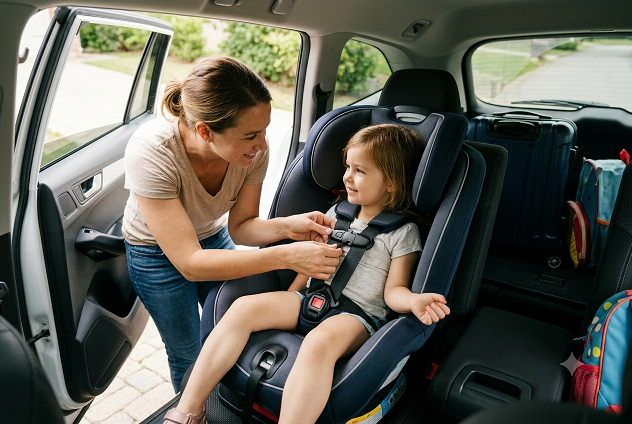
If you're traveling by car, taxi or another road vehicle, make sure your child is appropriately restrained according to their age, size and the applicable local requirements.
The CDC recommends that children use appropriate car seats or booster seats while traveling.
For parents driving in countries with different regulations, it's also important to check the local requirements before the trip.
If bringing your own car seat, don't assume that simply having one is enough.
It needs to be installed correctly.
The U.S. National Highway Traffic Safety Administration (NHTSA) advises parents to follow both the car-seat manufacturer's instructions and the vehicle owner's manual when installing a child restraint.
A useful rule: don't wait until the day of travel to figure out how the car seat works.
Practice beforehand.
3. Keep Children in the Safest Available Seating Position
Children should generally travel in the back seat when appropriate.
NHTSA recommends keeping children in the back seat through at least age 12 in its guidance, while exact legal requirements can vary by location.
Parents should also follow the specific instructions for the child's car seat, including height and weight limits and the appropriate direction of installation.
As children grow, the appropriate restraint changes.
A child may eventually move from a rear-facing seat to a forward-facing seat, then potentially to a booster and finally to a properly fitting seat belt.
These transitions should be based on the manufacturer's requirements and applicable local guidance rather than simply the child's age alone.
4. Teach Children Simple Travel-Safety Rules
Children don't need a complicated safety lecture before every trip.
A few simple rules are easier to remember.
For example:
Stay close to your parent or caregiver.
Don't leave a designated meeting area without telling an adult.
Don't accept food, gifts or invitations from unfamiliar people.
Tell an adult immediately if you feel uncomfortable, lost or unwell.
Don't run near roads, parking areas, platforms or moving vehicles.
The rules can be adjusted according to the child's age.
Younger children may need constant supervision, while older children can gradually learn how to respond to unfamiliar situations.
The objective is not to make children fearful of strangers or travel.
It is to give them simple actions they can remember.
5. Have a Plan in Case You Get Separated
Crowded airports, railway stations, shopping areas, theme parks and tourist attractions can make it surprisingly easy for a child and parent to become separated.
Before entering a crowded place, establish a simple plan.
For example:
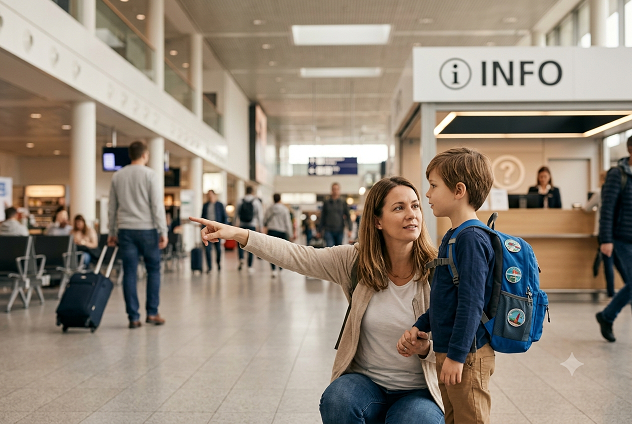
“If we can't find each other, stay where you are and look for a staff member or security officer.”
Older children can also be taught to remember a parent's name and phone number.
Depending on the child's age, parents may consider keeping essential contact information in an accessible form.
Some families also establish a meeting point before entering a large attraction.
The key is to discuss the plan before anyone becomes separated.
6. Keep Important Information Accessible
Travel documents and important information should be organized before departure.
Depending on the trip, this may include:
- Identification documents
- Travel tickets
- Emergency contact numbers
- Accommodation details
- Health or insurance information
- Relevant medical records
- Prescription information
- Copies of important documents
Keep essential information accessible rather than placing everything in one checked bag.
For international travel, requirements can vary by destination, so parents should verify the current documentation requirements before departure.
Digital copies can be useful as a backup, but important information should not exist only on a phone that could be lost, damaged or run out of battery.
7. Pack a Child-Friendly Travel Health Kit
A small travel health kit can make unexpected situations easier to manage.
Depending on your destination and your child's needs, it might include:
- Regular prescription medicines
- Basic first-aid supplies
- Hand sanitizer
- Sunscreen
- Insect repellent
- Commonly needed personal-care items
- Familiar snacks
- Any medically recommended supplies
The CDC recommends preparing a travel health kit and bringing sufficient prescription and over-the-counter medicines for the trip, along with items such as first-aid supplies and hand sanitizer.
However, medicines for children should be selected and used appropriately. Parents should not guess dosages or give unfamiliar medication without appropriate guidance.
8. Pay Attention to Food and Water
Children can sometimes be more sensitive to changes in food, water and routine.
When traveling, particularly internationally, parents should consider local food and water safety.
The CDC recommends choosing safer food and drinks while traveling and notes that hot, dry or packaged foods may be safer choices in locations where food and water safety is a concern.
Depending on the destination, families may also need to consider:
- Drinking-water safety
- Unpasteurized products
- Food that has been sitting out
- Raw or undercooked foods
- Food allergies
- Familiar snacks for younger children
Parents should research destination-specific recommendations rather than applying one rule to every country.
9. Encourage Regular Hand Hygiene
Travel involves many shared surfaces.
Airports, trains, buses, restaurants, attractions and public facilities can expose travelers to many germs.
The CDC recommends regular handwashing with soap and water and says that, when soap and water aren't available, an alcohol-based hand sanitizer containing at least 60% alcohol can be used.
For children, make hand hygiene part of the routine rather than presenting it as something they only need to do when they feel dirty.
Useful moments include:
- Before eating
- After using the restroom
- After outdoor activities
- After touching animals
- After arriving at a new location
Young children may need help washing their hands properly.
10. Be Careful Around Animals
Children are naturally curious about animals.
A friendly-looking dog, cat or other animal can quickly attract their attention.
However, children may not understand how an unfamiliar animal might react.
The CDC specifically advises close supervision around animals and notes that children can be at greater risk of animal-related health problems because of their size, curiosity and tendency to interact with animals.
Teach children:
Ask before touching an unfamiliar animal.
Don't approach wild animals.
Don't disturb animals while they are eating or caring for young.
Tell an adult immediately about a bite or scratch.
If an animal bite occurs, the wound should be washed thoroughly and appropriate medical attention sought promptly.
11. Take Water Safety Seriously
Swimming pools, beaches, lakes and water parks can be some of the most enjoyable parts of a family vacation.
They also require active supervision.
The CDC recommends closely supervising children around water and having them wear a life jacket during water activities where appropriate.
Parents shouldn't assume that a child who knows how to swim is automatically safe in every environment.
Conditions can change.
There may be waves, currents, deep water, slippery surfaces or unfamiliar pool layouts.
Follow local safety rules and use appropriate flotation equipment when required.
Most importantly, active adult supervision should not be replaced by a phone, camera or other distraction.
12. Protect Children From Weather and the Environment
A child may not always recognize when they are becoming too hot, cold or uncomfortable.
Before traveling, check the expected conditions and pack accordingly.
Depending on the destination, this could mean:
- Lightweight clothing
- Warm layers
- Hats
- Sunscreen
- Comfortable shoes
- Rain protection
- Adequate water
- Insect protection
The CDC recommends protection from sun exposure during travel and notes that UV exposure can occur even when the weather feels cool or cloudy.
For destinations with unusual climates or high elevations, parents should research specific risks before departure.
13. Don't Ignore Road and Pedestrian Safety
Travel often means navigating unfamiliar roads.
Traffic patterns, road signs and driving practices may differ from what children are accustomed to at home.
Teach children to:
- Hold an adult's hand when appropriate
- Stay away from moving vehicles
- Use designated crossings
- Follow local pedestrian signals
- Never run into a road
- Remain seated and buckled during vehicle travel
The CDC identifies motor-vehicle crashes as a major travel safety concern and recommends seat belts, appropriate child restraints and attention to local traffic conditions and laws.
When using taxis or ride services, parents should check how child restraints are handled in the destination and consider bringing an appropriate restraint when necessary and practical.
14. Don't Let Technology Replace Supervision
Phones and GPS tools can be useful while traveling.
Parents can use them for:
- Maps
- Emergency contacts
- Translation
- Travel information
- Location sharing
- Digital copies of documents
But technology should support supervision rather than replace it.
For example, a location-sharing feature shouldn't become an excuse to stop paying attention to a child near a busy road or swimming pool.
Similarly, a smartwatch doesn't eliminate the need to teach children what to do if they become separated.
Technology is a backup tool—not a substitute for responsible supervision.
15. Let Children Participate in Safety Planning
One of the best ways to build safer travel habits is to involve children in the process.
Ask them:
“What should we do if we can't find each other?”
“Who could we ask for help?”
“What should you do before crossing the road?”
“When should you tell me that you're not feeling well?”
This turns safety from a list of restrictions into practical knowledge.
Older children can gradually take more responsibility for their own belongings, documents, phone numbers and travel awareness.
The level of responsibility should always match the child's age and maturity.
A Simple Family Travel Safety Checklist
Before leaving home, ask:
Transportation
- Is the child's restraint appropriate and correctly installed?
- Are seat belts available for everyone?
- Have we checked local transportation rules?
Health
- Do we have necessary medicines?
- Have we checked destination-specific health advice?
- Do we have basic first-aid supplies?
Food & Water
- Do we know whether local tap water is safe?
- Are suitable foods available for our child?
- Have we packed familiar snacks if needed?
Supervision
- Does the child know what to do if separated?
- Have we established a meeting point?
- Do children know basic road and water-safety rules?
Documents
- Are essential documents accessible?
- Do we have emergency contact information?
- Do we have backup copies where appropriate?
A five-minute check before departure can prevent many avoidable problems later.

Inkauras Insight
Keeping children safe while traveling isn't about being afraid of every possible risk. It's about preparing for the situations that are reasonably foreseeable.
A properly fitted child restraint.
A simple separation plan.
Safe food and water habits.
Close supervision around water and animals.
Essential medicines and documents.
These aren't complicated measures, but they can make family travel more organized and safer.
The best travel safety plan is one that is practical enough to follow consistently.
Final Thought
Family travel doesn't have to become a checklist of things that could go wrong.
The purpose of preparation is actually the opposite: to give parents more confidence to enjoy the journey.
Children learn from the way adults behave. When parents calmly prepare, explain simple rules and pay attention to their surroundings, children gradually learn how to travel responsibly too.
You don't need to predict every possible problem.
Just prepare for the important ones, supervise appropriately and keep the basics within reach.
A safer family trip begins long before you reach your destination.
Important Disclaimer
This article is intended for general educational and informational purposes only. It is not a substitute for professional medical, travel, legal or child-safety advice.
Travel safety requirements can differ significantly between countries, states, transportation providers and destinations. Car-seat requirements, documentation rules, vaccination recommendations and health precautions should be checked against current official guidance applicable to your specific trip.
For children with medical conditions, special needs, allergies or medication requirements, parents should consult an appropriate healthcare professional before traveling.
Share your views in comment section.
Rate this article
Sign in to rate this article.