
How to Make Learning More Enjoyable
Learning requires discipline and effort, but it does not have to feel like a tedious chore to be effective. By fostering intrinsic motivation and connecting subjects to personal interests, you can make the learning process both deeply meaningful and sustainable.
InkAuras
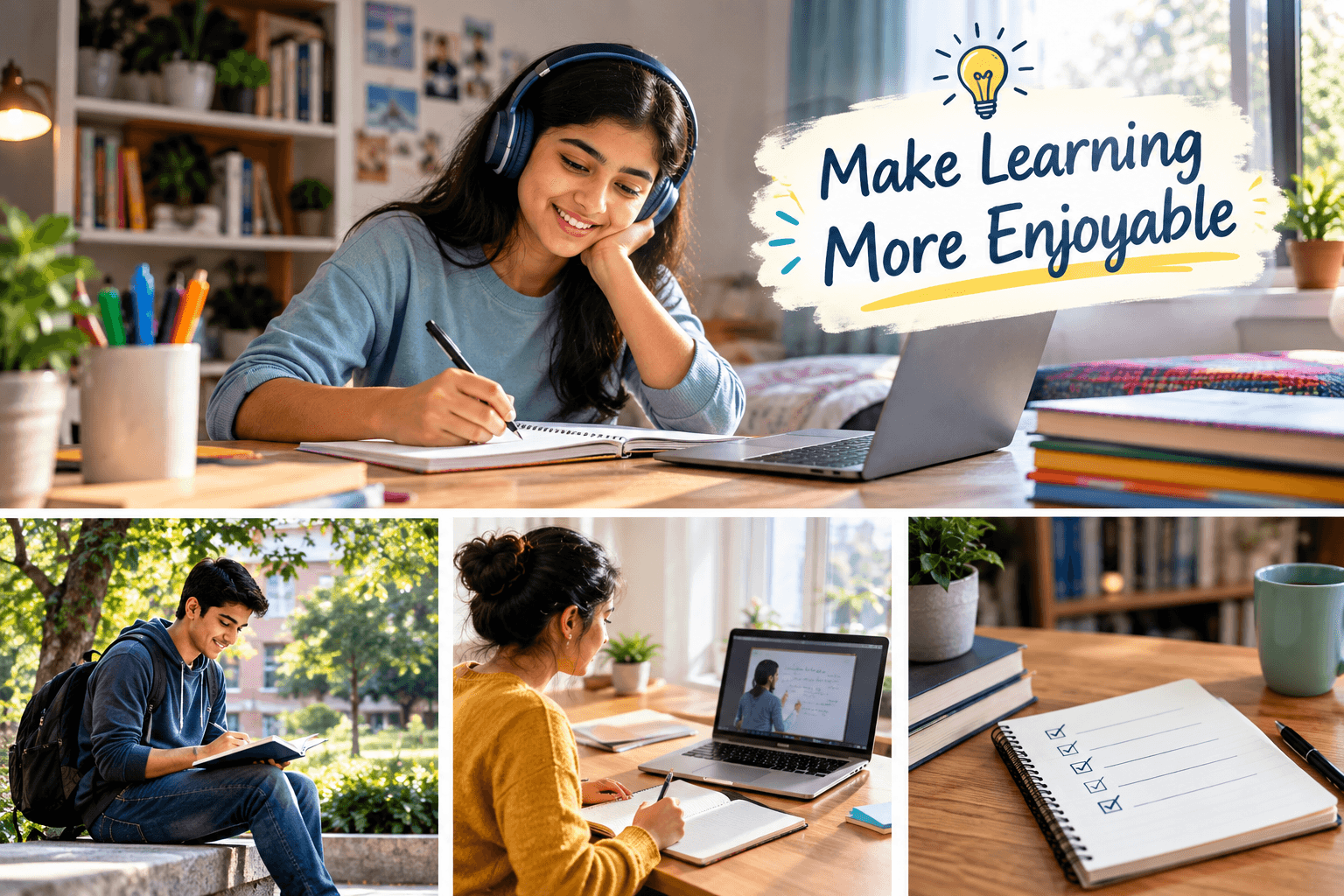
Introduction
Learning is often presented as something that requires discipline, concentration and hard work. While these qualities certainly matter, learning does not always have to feel like a chore.
Whether you are a school student, college learner, working professional or someone learning a new skill for personal interest, enjoyment can make the process more engaging and sustainable.
Enjoyable learning does not mean making every lesson entertaining. Some subjects will naturally be difficult or less interesting. Instead, it means finding ways to make learning more meaningful, interactive, achievable and connected to your interests.
Research in educational psychology suggests that motivation, autonomy, competence and meaningful engagement can influence how learners approach educational activities. The American Psychological Association notes that students tend to enjoy learning more when they are intrinsically motivated, although both intrinsic and extrinsic motivation can play a role in learning.
Here are some practical ways to make learning more enjoyable without losing sight of the actual purpose of education.
1. Connect Learning With Real Life
One of the easiest ways to make a topic more interesting is to understand why it matters.
A mathematical formula can seem abstract when studied only from a textbook. But the same concept may become more meaningful when connected to budgeting, measurements, technology or everyday problem-solving.
Similarly, learning about science can become more engaging when you connect it with cooking, health, weather, nature or technology.
Before beginning a topic, ask:
“Where could I use this in real life?”
You may discover that a subject has more practical relevance than you initially thought.
This approach can also help learners understand that education is not simply about remembering information for an examination.
2. Give Yourself Some Choice
Having some control over how you learn can make the experience more engaging.
For example, if you need to learn about a historical period, you might choose whether to begin with a book, documentary, timeline or educational video.
If you are learning a language, you might choose topics that genuinely interest you—travel, food, sports, movies or technology.
Self-Determination Theory highlights autonomy, competence and relatedness as important psychological needs associated with motivation. In educational settings, providing appropriate choices can support students' sense of autonomy.
Choice does not mean avoiding difficult subjects. It means finding reasonable ways to participate actively in the learning process.
3. Break Large Topics Into Smaller Goals
A large chapter, course or skill can feel overwhelming when viewed as one enormous task.
Instead of saying:
“I have to learn this entire chapter today.”
try:
“Today I will understand these three concepts.”
Smaller goals make progress easier to see.
They can also create a sense of competence—the feeling that you are gradually becoming capable of doing something that previously seemed difficult.
You can divide learning into:
- One concept
- One chapter section
- Five practice questions
- Ten new vocabulary words
- One practical exercise
- One short revision session
Progress does not have to be dramatic to be meaningful.
4. Make Learning Active
Simply reading information repeatedly is not always the most engaging way to learn.
Try doing something with the information instead.
You could:
- Explain the concept in your own words.
- Create questions and answer them.
- Solve practice problems.
- Draw a simple diagram.
- Teach the idea to someone else.
- Write a short summary from memory.
- Apply the concept to a real situation.
The Institute of Education Sciences highlights strategies such as retrieval practice, spacing, interleaving and feedback-driven metacognition as useful approaches supported by research. Retrieval practice, for example, involves actively recalling information instead of simply rereading it.
Active learning can therefore make study sessions more interactive while also encouraging deeper engagement with the material.

5. Use Different Learning Formats
Doing exactly the same activity every day can become repetitive.
Depending on the subject, you might alternate between:
Reading → Watching → Practicing → Discussing → Explaining → Applying
For example, when learning a new technology, you could first read the basic concepts, watch a demonstration, build a small project and then explain what you learned to someone else.
The objective isn't to constantly switch methods simply for entertainment. The method should still match the learning goal.
Use variety when it genuinely helps you understand or practice the subject.
6. Make Difficult Learning Feel Achievable
Learning becomes frustrating when the difficulty is consistently far beyond your current ability.
At the same time, material that is always extremely easy may not provide enough challenge.
A useful approach is to gradually increase difficulty.
Suppose you are learning mathematics.
Start with basic problems, understand the underlying concept and then move toward more complex questions.
If you make mistakes, treat them as information about what you need to practice rather than as proof that you are “bad at the subject.”
The educational motivation literature emphasizes the importance of supporting learners' sense of competence, including through appropriately challenging activities and useful feedback.
7. Learn With Other People
Learning does not always have to happen alone.
A study partner, teacher, colleague, friend or discussion group can make learning more interactive.
You might discuss a difficult topic, solve a problem together or explain different approaches to the same question.
This can also provide accountability. Knowing that someone else will discuss a topic with you may make it easier to start.
Self-Determination Theory identifies relatedness—the feeling of meaningful connection with others—as one of the psychological needs relevant to motivation.
However, group learning should remain supportive rather than becoming a competition over grades or performance.
8. Use Technology as a Tool, Not a Replacement
Educational videos, digital flashcards, simulations, online courses and interactive applications can make certain subjects easier to explore.
Technology can be particularly useful when it allows you to see something that is difficult to understand through text alone.
But more technology does not automatically mean better learning.
A learner can spend an hour watching educational videos without actually practicing or remembering much of the material.
Use technology to support active learning, not simply to consume more content.
For example:
Watch a short explanation → close the video → recall the main ideas → practice → check your understanding.
That is often more useful than continuously watching related videos.

9. Celebrate Progress Without Becoming Dependent on Rewards
Small rewards can sometimes help create structure around learning.
For example, you might take a short break after completing a focused study session.
However, learning does not need to become entirely dependent on external rewards.
The APA notes that intrinsic and extrinsic motivation can both contribute to learning, while intrinsically motivated learners engage in activities because they find them personally rewarding.
Over time, try to notice internal rewards as well:
- “I understand this now.”
- “I can solve this problem.”
- “I can explain this concept.”
- “I am improving.”
- “I can use this skill in real life.”
That sense of progress can itself become motivating.
10. Allow Learning to Be Imperfect
One reason people stop enjoying learning is that they expect themselves to understand everything immediately.
Real learning usually includes confusion, mistakes, repetition and periods where progress feels slow.
Instead of asking:
“Why don't I understand this yet?”
try asking:
“What part of this do I understand, and what part do I need to practice?”
This changes the experience from self-judgment to problem-solving.
It also creates a healthier relationship with mistakes.
A Simple Learning Routine
You don't need an elaborate system to begin.
Try this simple structure:
Choose one topic → Set a small goal → Learn actively → Practice → Check your understanding → Take a short break → Review later.
For example, a 30-minute session could look like:
- 5 minutes: Review what you already know
- 10 minutes: Learn a new concept
- 10 minutes: Practice or recall it without looking
- 5 minutes: Write down what you understood and what remains unclear
You can adjust the timing according to your age, subject and circumstances.

Inkauras Insight
Enjoyable learning is not about making every subject fun. It is about making learning meaningful enough to continue.
Give yourself reasonable choices. Connect subjects with real life. Break difficult topics into smaller goals. Practice instead of only rereading. Learn with others when useful. And allow yourself to make mistakes.
Most importantly, don't compare your learning speed with someone else's.
Different learners have different backgrounds, interests, responsibilities and starting points.
The goal is not to make every study session exciting.
The goal is to make learning feel possible, purposeful and worth continuing.
Final Thought
Learning becomes more enjoyable when you can see progress and understand why the effort matters.
You don't need expensive courses, complicated productivity systems or hours of study every day to become a better learner.
Start with one subject, one small goal and one practical learning method.
Over time, curiosity can become a habit—and learning can become something you do not simply have to complete, but something you genuinely want to continue.
Disclaimer
This article is provided for general educational and informational purposes only. It is not a substitute for individualized educational, psychological or professional advice.
Learning preferences, educational needs and challenges vary from person to person. Students experiencing persistent academic difficulties, significant anxiety or other concerns may benefit from speaking with an appropriate teacher, educational professional, counselor or qualified healthcare professional.
The strategies discussed here are general suggestions and may not work equally well for every learner.
Share you views in the comment section.
Rate this article
Sign in to rate this article.