
Travel Essentials Parents Often Forget
While parents routinely pack obvious items like clothes and tickets, overlooking essential details like spare cables, necessary medications, or document copies can quickly derail a trip. Preparing a simple, thoughtful checklist before heading out prevents unexpected stress and ensures a smooth family journey.
InkAuras

Introduction
Family trips are exciting, but travelling with children requires a little more planning than simply packing clothes and booking tickets.
Parents usually remember the obvious things: clothes, shoes, toiletries, tickets and perhaps a favorite toy. Yet some of the most useful items are the ones that are easy to overlook.
A missing charging cable can become an inconvenience. Forgetting a child's regular medicine can create a much bigger problem. Not having copies of important documents can make an already stressful situation harder to manage.
The good news is that most of these situations can be avoided with a simple checklist.
Here are some travel essentials parents often forget, along with practical ways to prepare for them.
1. Copies of Important Documents
Passports, visas, tickets and identification documents are obvious travel essentials.
What parents sometimes forget is having backup copies.
Consider keeping secure digital and/or printed copies of important documents such as:
- Passport and visa
- Travel tickets
- Hotel or accommodation details
- Travel insurance information
- Emergency contact details
- Relevant medical documents
- Children's identification or school documents, when appropriate
The exact documentation required depends on the destination and type of travel.
For international travel, requirements can change, so check the relevant official government or airline information before departure. The IATA Travel Centre provides current passport, visa and health requirement information based on official sources.
A useful habit is to keep copies in more than one secure location rather than putting everything in the same bag.
2. Children's Regular Medicines
This is one of the easiest things to overlook during the excitement of packing.
If your child regularly takes prescribed medication, don't leave it until the last moment.
The CDC recommends carrying necessary medicines in your travel health kit and taking enough for the trip, plus some extra in case of travel delays. It also advises keeping medicines in carry-on luggage when flying.
For regular medication, parents should consider carrying:
- The prescribed medicine
- Prescription or relevant medical documentation
- Dosage information
- A little extra for unexpected delays, where appropriate
- Any necessary storage equipment
Keep medicines in their original labelled containers where practical.
For international travel, also check whether a particular medicine is permitted in the destination country. Some medicines that are commonly available in one country may be subject to restrictions elsewhere.
3. A Small Child-Friendly First-Aid Kit
You don't necessarily need a large medical kit.
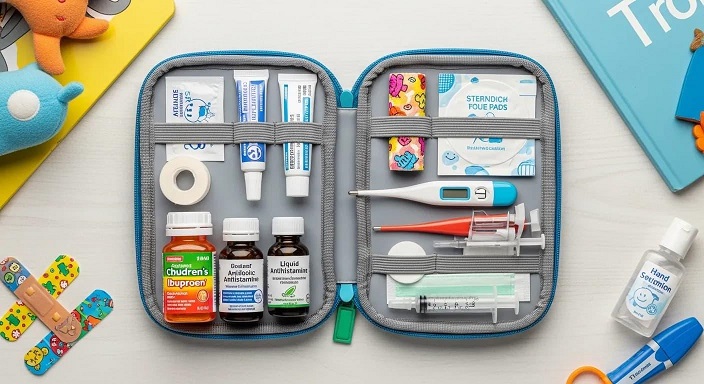
A compact first-aid pouch can be useful for everyday situations such as minor cuts, scrapes or blisters.
Depending on your family's needs, it might include:
- Adhesive bandages
- Antiseptic or appropriate wound-care supplies
- Gauze
- Thermometer
- Any regularly used medical supplies
- Doctor-recommended medicines
The contents should depend on your destination, activities and your child's individual needs.
The CDC recommends preparing a travel health kit with items that may be difficult to find while travelling.
Parents should avoid carrying or giving medicines simply because they are commonly recommended online. Medication choices and dosages, particularly for children, should be based on appropriate professional guidance.
4. Extra Clothes in the Carry-On
A suitcase can contain enough clothes for an entire week, but what happens if your checked luggage doesn't arrive with you?
Or if your child spills a drink on their clothes during the flight?
Keeping one complete change of clothes for each child in your carry-on can be surprisingly useful.
For younger children, consider including:
- T-shirt or top
- Trousers or shorts
- Underwear
- Socks
- Lightweight outer layer
For babies and toddlers, you may want to carry additional clothing depending on the journey.
This takes very little space but can make an unexpected situation much easier to handle.
5. Snacks and Familiar Food
Travel can disrupt normal meal schedules.
Children may become hungry while waiting at an airport, during a long road journey or when travelling between destinations.
Parents often remember meals but forget to carry a few suitable backup snacks.
Depending on the journey and applicable transport rules, consider options such as:
- Dry snacks
- Fruit
- Crackers
- Nuts, if age-appropriate and safe for your child
- Familiar packaged foods
- Water
If your child has food allergies or dietary restrictions, planning becomes even more important.
The CDC recommends that travelers with food allergies prepare appropriately and carry information about their allergies, including translated information when travelling internationally.
Always check airline, airport and destination-specific rules before carrying food.
6. Chargers, Power Banks and the Small Electronics
Parents often remember the phone but forget what keeps it working.
Before leaving, check the charging requirements for:
- Smartphones
- Tablets
- Smartwatches
- Wireless headphones
- Cameras
- Children's electronic devices
Depending on your destination, you may also need an appropriate travel adapter.
A simple solution is to create a small electronics pouch containing the cables and accessories your family needs.
Before packing, charge essential devices and check the rules of your airline regarding power banks and other batteries.
7. A Familiar Comfort Item
This one isn't about technology or documents.
For younger children especially, a familiar object can make an unfamiliar environment feel a little more comfortable.
It could be:
- A favorite small toy
- A blanket
- A book
- A soft toy
- A familiar bedtime item
You don't need to pack an entire toy box.
One or two familiar items may be enough.
Just remember to keep them somewhere accessible rather than buried inside checked luggage.
8. Entertainment for Waiting Time
Travel often involves waiting.
Airport security, boarding, delays, traffic, hotel check-in and restaurant queues can all test a child's patience.
A little preparation can make these moments easier.
Depending on the child's age, consider:
- Books
- Drawing materials
- Small games
- Puzzles
- Downloaded movies or shows
- Headphones
- Offline games or educational content
Don't rely entirely on internet access. Download anything you expect to use before leaving home.
Also consider giving children some screen-free options.
A small activity book can be just as useful during a long wait.
9. Emergency Contact Information
Most parents have important phone numbers saved in their phones.
But what happens if a phone is lost, damaged or has no battery?
A simple emergency contact card can be useful.
It could include:
- Parent or guardian names
- Phone numbers
- Accommodation details
- Emergency contact
- Relevant medical information, where appropriate
For children old enough to understand, parents can also teach them how to identify a trusted adult or seek help if they become separated.
The CDC recommends carrying emergency contact information and leaving copies of important travel details with someone at home.
10. Travel Insurance and Health Information
Travel insurance is not something you put into a suitcase, but it is something parents can easily forget to check.
Before travelling, understand what your existing health or travel insurance covers and whether additional coverage is appropriate for your trip.
This is particularly worth considering when travelling internationally or visiting remote locations.
The CDC recommends travelers check their health insurance coverage and consider travel insurance that may cover healthcare or emergency evacuation depending on the circumstances.
Families travelling with children who have ongoing medical needs should also consider discussing destination-specific requirements with an appropriate healthcare professional before departure.
11. A Few Things for the Journey, Not Just the Destination
Parents often pack according to the number of days they'll be away.
But travel itself can create unexpected needs.
Think about the journey separately from the holiday.
For example:
During
the journey:
Snacks, water, medicines, entertainment, headphones, spare clothes and
chargers.
At the
destination:
Clothes, toiletries, shoes, activity equipment and other planned items.
This simple distinction can make packing more practical.
You may discover that some of the most important items need to stay in your hand luggage rather than inside the main suitcase.
A Simple Family Travel Checklist
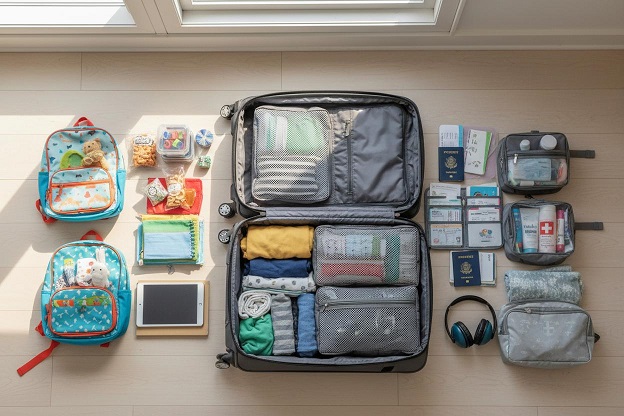
Before leaving home, quickly check these categories:
📄 Documents
Passport, visa, tickets, accommodation details and backup copies.
💊 Health
Regular medicines, prescriptions, first-aid supplies and relevant medical information.
👕 Clothing
Enough clothing plus at least one practical change in the carry-on for children.
🍎 Food
Suitable snacks and any special dietary items.
🔌 Technology
Chargers, adapters, headphones and other essential accessories.
🧸 Comfort
Favourite toy, book, blanket or other familiar item.
🎨 Entertainment
Books, games, drawing materials or downloaded content.
📞 Emergency
Important phone numbers and accommodation information.
🛡️ Protection
Travel insurance details and destination-specific safety information.
Inkauras Insight
The best family packing list isn't necessarily the longest one.
It is the one that helps you prepare for the situations you are most likely to encounter.
Instead of asking:
"What can I possibly take with me?"
Ask:
"What would be difficult to replace if we needed it unexpectedly?"
That question can quickly highlight the essentials.
A child's regular medication may be difficult to replace.
A passport certainly is.
A favorite toy might be surprisingly important to a young child.
A spare T-shirt may save you from an uncomfortable few hour.
Thinking this way can make packing more purposeful rather than simply making your bags heavier.
Final Thoughts
Travelling with children doesn't have to mean carrying everything you own.
It means preparing thoughtfully for the things that matter.
Documents, medicines, spare clothes, snacks, chargers, emergency contacts and a few familiar items can make a significant difference when something doesn't go exactly according to plan.
Every family is different, and every destination creates different requirements.
So use this article as a starting point rather than a universal packing list.
Check your destination. Check your travel provider. Check your family's specific needs. Then pack accordingly.
A few extra minutes of preparation at home can make the journey much more comfortable for everyone.
And perhaps the most important travel essential of all?
A little patience.
Because even the best-packed family trip can still include a missed nap, a delayed flight, a spilled drink or the inevitable question:
"Are we there yet?" 😊
Travel & Safety Disclaimer
This article is provided for general informational and educational purposes only. It is not medical, legal, immigration, insurance or other professional advice.
Travel requirements, visa rules, airline policies, health recommendations and entry conditions can change and vary by destination. Always verify current requirements with the relevant government authority, airline, accommodation provider, insurer or qualified professional before travelling.
For children with medical conditions, allergies or regular medication needs, parents or guardians should seek appropriate professional advice based on the child's individual circumstances.
Share your views in comment section.
Rate this article
Sign in to rate this article.