
What Happens to Our Mind When We Are Stressed?
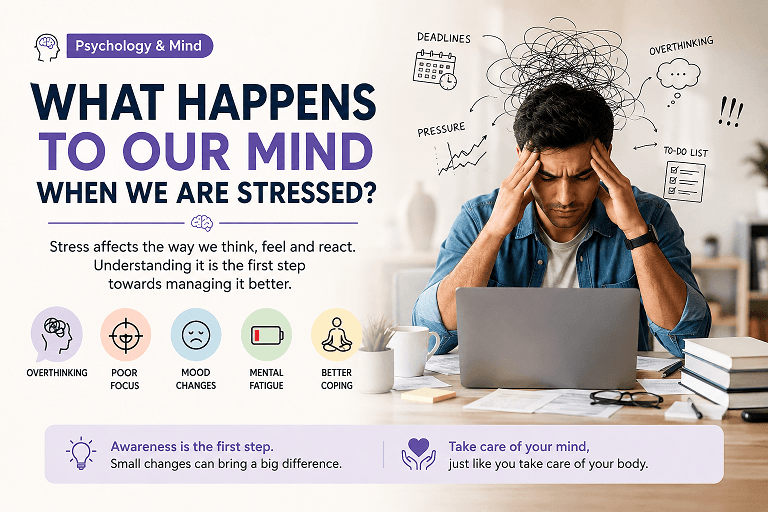
While stress can serve as a short-term motivator during challenging situations, prolonged or intense pressure significantly impacts our mood, focus, and ability to relax. Recognizing how stress affects our minds helps us identify it early and respond with greater clarity and care.
Abhinav Sharma
Introduction
Stress is something almost everyone experiences.
A difficult deadline, financial pressure, relationship problems, uncertainty about the future, an important exam or even a long list of unfinished tasks can make us feel stressed.
Sometimes stress can motivate us to respond to a challenge. But when stress becomes intense or continues for a long period, it can begin to affect how we think, feel, concentrate and respond to everyday situations.
You may notice that you're more irritable than usual, finding it difficult to concentrate, constantly thinking about a problem or struggling to relax.
So what is actually happening inside our mind when we're stressed?
Understanding the process can help us recognize stress earlier and respond to it more thoughtfully.
What Is Stress?
Stress can be understood as the physical or mental response to an external cause, such as a difficult situation, major life change, workload or illness. The cause itself is often called a stressor.
Stress isn't always harmful.
A certain amount of stress can help us respond to challenges and meet deadlines. The American Psychological Association notes that short-term stress can sometimes motivate performance and problem-solving.
The difficulty arises when stress becomes overwhelming, frequent or persistent.
That's when our normal stress response can start affecting everyday well-being.

1. Your Mind Goes Into "Alert Mode"
When your brain perceives a situation as threatening or demanding, your body can activate a stress response.
You might suddenly become more alert.
Your heart may beat faster. Your muscles may become tense. You may start paying close attention to what could go wrong.
This response is part of the body's natural fight-or-flight system.
Stress hormones such as adrenaline and cortisol help prepare the body to respond to a challenge.
For a short-term challenge, this can be useful.
For example, if you're about to give an important presentation, a little nervous energy may help you stay focused.
But if your mind remains in this alert state for too long, it can become exhausting.
2. Concentration Can Become More Difficult
Have you ever tried to complete an important task while worrying about something else?
You read the same sentence several times.
You open your laptop but can't seem to get started.
You try to focus on a conversation while your mind keeps returning to another problem.
Stress can affect concentration and clear thinking. NIMH lists difficulty concentrating among the common experiences associated with stress, while the APA notes that prolonged stress can contribute to concentration and memory difficulties.
This doesn't mean that every moment of forgetfulness is caused by stress.
But when you're under significant pressure, your mental attention may be pulled toward the source of that pressure.
3. Your Thoughts May Become More Negative
Stress can influence the way we interpret situations.
A small mistake may start feeling like a major failure.
A delayed reply may make you wonder whether someone is upset with you.
An uncertain situation may lead you to imagine several negative outcomes.
This doesn't mean stress automatically creates negative thinking. People respond differently to stressful situations. But when you're already mentally overloaded, it can become harder to step back and look at a situation calmly.
That's why a useful question during a stressful moment can be:
"What do I actually know, and what am I assuming?"
Separating facts from assumptions can sometimes help create a little mental distance.
4. Your Emotions May Become Stronger
Stress doesn't always appear as worry.
You might experience:
- Irritability
- Frustration
- Restlessness
- Feeling overwhelmed
- Sadness
- Difficulty relaxing
- Reduced patience
The World Health Organization notes that stress can involve emotions such as anxiety and irritability and can make it difficult to relax.
This is one reason a small problem can sometimes produce a surprisingly large emotional response.
The problem may be small.
Your mental capacity may simply be running low.
5. Your Mind May Keep Replaying the Problem
Another common experience during stressful periods is repeatedly thinking about the same issue.
You may replay a conversation.
Think about what you should have said.
Imagine what might happen tomorrow.
Try to solve a problem that cannot currently be solved.
This mental repetition can make it difficult to switch off, particularly when the source of stress is unresolved.
And when you can't mentally disconnect from a problem, relaxing or falling asleep may become more difficult.
This can create an uncomfortable cycle:
Stress → repetitive thoughts → difficulty relaxing → poor sleep → greater difficulty coping with stress.
6. Stress Can Affect Sleep
The connection between stress and sleep can work in both directions.
A stressful day can make it harder to relax at bedtime, while insufficient sleep can make it more difficult to manage everyday stress.
NIMH identifies sleep problems among the possible effects associated with stress and anxiety.
If your mind becomes particularly active at night, a simple routine may help:
- Write down tomorrow's important tasks.
- Put away work-related activities.
- Reduce stimulating screen activity before bed.
- Give yourself time to relax.
- Maintain a reasonably consistent sleep schedule.
These habits aren't guaranteed solutions for persistent sleep problems, but they can support healthier routines.
7. Your Body and Mind Are Not Separate
It's tempting to think of stress as "something happening in the mind."
In reality, stress can affect both psychological and physical processes.
The APA notes that stress can influence multiple body systems, including the nervous, cardiovascular, respiratory, gastrointestinal and musculoskeletal systems.
You might notice:
- Muscle tension
- Headaches
- Stomach discomfort
- Faster heartbeat
- Sweating
- Changes in appetite
- Difficulty sleeping
These experiences don't necessarily mean that stress is the only possible cause.
Physical symptoms can have many causes, so persistent or concerning symptoms should not automatically be attributed to stress.

Short-Term Stress vs. Long-Term Stress
This distinction is important.
Short-term stress
A deadline approaches.
You feel nervous.
You concentrate on the task.
The deadline passes.
Your body gradually settles down.
Long-term stress
The pressure continues for weeks or months.
There is no clear opportunity to recover.
You remain worried, tense or mentally exhausted.
Over time, persistent stress can affect both physical and psychological well-being. The APA describes chronic stress as stress that continues over an extended period and can contribute to problems such as sleep difficulties, irritability, muscle tension and concentration problems.
The goal isn't to eliminate every stressful experience.
It's to recognize when stress is becoming difficult to manage.
What Can You Do When You Feel Stressed?
There isn't one technique that works for everyone.
NIMH recommends approaches such as identifying stress triggers, keeping a journal, physical activity, maintaining regular sleep and meals, relaxation or mindfulness exercises, challenging unhelpful thoughts and reaching out to supportive people.
You could start with something simple.
Pause
Give yourself a few minutes before reacting.
Identify
Ask:
"What exactly is stressing me right now?"
Prioritize
Separate what needs immediate attention from what can wait.
Move
Take a short walk or stretch if possible.
Connect
Talk to someone you trust rather than carrying everything alone.
Rest
Give your mind opportunities to recover.
WHO also recommends maintaining routines, getting adequate sleep and learning practical stress-management skills.

When Should You Seek Professional Support?
Feeling stressed occasionally is a normal part of life.
However, if stress becomes persistent, feels difficult to manage, causes you to avoid everyday activities or begins interfering with your work, relationships, sleep or normal functioning, it may be time to seek professional support.
NIMH specifically recommends seeking help when symptoms don't go away or begin interfering with everyday life.
You don't have to wait until you feel completely overwhelmed.
Speaking with a qualified mental-health professional or healthcare provider can be a responsible step when stress becomes difficult to manage.
Inkauras Insight
When you're stressed, it's easy to think:
"Why can't I just calm down?"
Instead, try asking:
"What is my mind trying to deal with right now?"
Stress is not a sign that you're weak or incapable.
It is a normal human response to challenging circumstances.
The important part is learning to recognize when your stress response is helping you respond to a challenge—and when it is beginning to take more from you than the situation requires.
A Simple Stress Check-In
The next time you feel overwhelmed, take a minute and ask yourself:
- What am I feeling?
- What triggered it?
- Is the situation temporary or ongoing?
- Am I tired or lacking sleep?
- What can I control right now?
- What can wait?
- Would talking to someone help?
You don't need to solve everything immediately.
Sometimes the first step is simply understanding what is happening.

Final Thoughts
Stress affects more than our mood.
It can influence our attention, thoughts, emotions, sleep and physical responses.
Short-term stress can sometimes help us respond to challenges. But when stress becomes persistent, it deserves attention rather than being dismissed as simply "part of life."
The good news is that understanding your stress response is itself a useful first step.
Notice it. Understand it. Give yourself room to respond rather than simply react.
And when stress becomes difficult to manage, asking for professional support is not a weakness—it is a responsible choice.
Important Mental Well-being Disclaimer
This article is intended for general educational and mental-wellness information only. It is not a diagnosis and should not be considered a substitute for professional psychological, psychiatric or medical advice.
Stress affects people differently, and symptoms such as headaches, sleep problems, changes in appetite or difficulty concentrating can have many possible causes. If symptoms persist, become severe or interfere with everyday life, consult an appropriately qualified healthcare professional.
Share your thoughts in comment section.
Rate this article
Sign in to rate this article.