
What Is Personal Finance?
Personal finance is the process of managing your income, expenses, savings, investments, and insurance to achieve your long-term life goals. It starts with simply understanding your own money, requiring no complex economics expertise to build a clearer financial picture.
InkAuras

Introduction
We all earn, spend, save and make financial decisions.
But how often do we actually stop and look at the bigger picture?
You may know how much salary comes into your bank account every month. You may also know your rent, household expenses, loan payments and other regular costs. Yet, without a clear understanding of where your money is going and what you want it to achieve, managing finances can become difficult.
This is where personal finance comes in.
Personal finance is essentially about how an individual or household manages income, expenses, savings, borrowing, investments, insurance and financial goals.
The Securities and Exchange Board of India (SEBI) describes financial planning as the process of managing finances to work toward life goals, while the National Centre for Financial Education (NCFE) includes areas such as income and expenditure, savings, banking, credit, insurance, investments and retirement planning within financial education.
Personal finance doesn't require you to be an expert in economics.
It starts with understanding your own money.
What Does Personal Finance Actually Mean?
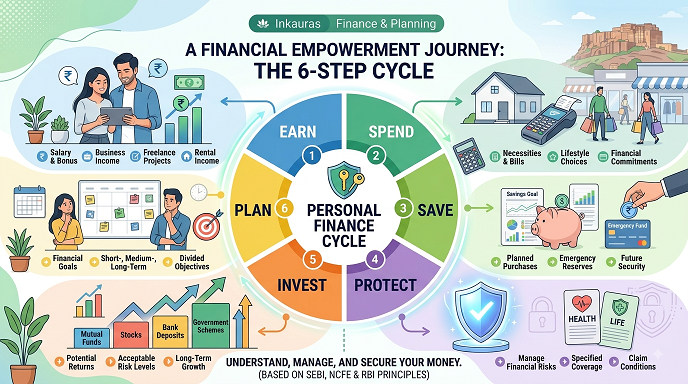
Imagine your money journey as a simple cycle:
Earn → Spend → Save → Protect → Invest → Plan
You earn money through salary, business, freelance work or other sources.
You spend money on necessities and things you value.
You save some money for future needs.
You protect yourself against certain financial risks through appropriate insurance and emergency reserves.
You may invest some money for longer-term goals.
And throughout the process, you make decisions based on your circumstances and priorities.
That entire process forms part of personal finance.
It isn't only about becoming wealthy.
It is about managing the money you have in a more organized and informed way.
1. Income: Know Where Your Money Comes From
The starting point of personal finance is income.
For many people, this is a monthly salary. For others, it could include business income, freelance earnings, rental income, interest or other legitimate sources.
Understanding your income means knowing not just your headline salary, but what actually reaches you after applicable deductions.
For example:
Gross salary → deductions → take-home income
Your financial decisions should generally be based on the money you actually have available rather than an amount that exists only on paper.
If your income changes from month to month, such as with freelance or business earnings, tracking income over a longer period can provide a clearer picture.
2. Expenses: Where Does Your Money Go?
Knowing your income is only half the story.
The next question is:
Where is the money going?
Expenses can broadly be divided into categories such as:
Essential expenses
Rent, groceries, utilities, transportation and other necessary costs.
Financial commitments
Loan payments, insurance premiums and other obligations.
Lifestyle expenses
Eating out, entertainment, shopping, travel and hobbies.
Irregular expenses
Medical costs, repairs, annual fees, gifts or other expenses that don't occur every month.
Keeping track of these expenses can reveal patterns that aren't obvious when you're simply looking at your bank balance.
NCFE recommends recording expenses and comparing total income with total expenditure as part of the budgeting process.
3. Budgeting: Give Your Money a Plan
A budget is simply a plan for how you expect to use your money.
It doesn't have to be complicated.
You could start with four basic questions:
How much money comes in?
How much goes toward essentials?
How much goes toward discretionary spending?
How much can be saved or allocated toward financial goals?
SEBI's financial education material describes budgeting as an important part of controlling day-to-day financial affairs and recommends gathering information about income, expenses, bills and financial accounts before preparing a budget.
A budget isn't supposed to prevent you from enjoying your money.
Instead, it can help you understand whether your spending is aligned with your priorities.

4. Saving: Prepare for the Future
Saving means setting aside part of your income rather than spending all of it immediately.
People save for different reasons:
- Emergency needs
- Short-term purchases
- Education
- Travel
- A home
- Family requirements
- Retirement
- Other personal goals
RBI financial education material encourages people to assess their current financial position, identify short-, medium- and long-term needs, estimate future costs and review savings regularly.
One useful mindset is to treat saving as something planned rather than something that happens only if money is left over at the end of the month.
However, the amount you can save will depend on your income, expenses and circumstances.
5. Emergency Savings: Prepare for the Unexpected
Life doesn't always follow a budget.
A sudden medical expense, job interruption, urgent repair or family emergency can create an unexpected financial burden.
This is why emergency savings are an important part of financial planning.
The purpose isn't to predict exactly what will happen.
It's to create some financial flexibility if something unexpected occurs.
The appropriate amount will differ from person to person depending on factors such as income stability, household responsibilities, existing financial commitments and access to other resources.
There is no universal number that every individual must follow.
6. Borrowing Is Also Part of Personal Finance
Loans and credit cards can be useful financial tools when used responsibly.
Home loans, education loans, vehicle loans and other forms of credit can help people meet significant financial needs.
But borrowing also creates an obligation to repay.
Before taking on debt, it is useful to understand:
- Total amount borrowed
- Interest rate
- Repayment period
- Monthly payment
- Fees and charges
- Consequences of delayed payments
- Total amount payable
RBI and NCFE financial education materials include responsible borrowing and credit discipline among important areas of financial literacy.
The important point is not that all debt is bad.
It is that borrowing should be understood before it is accepted.
7. Investing Is Different From Saving
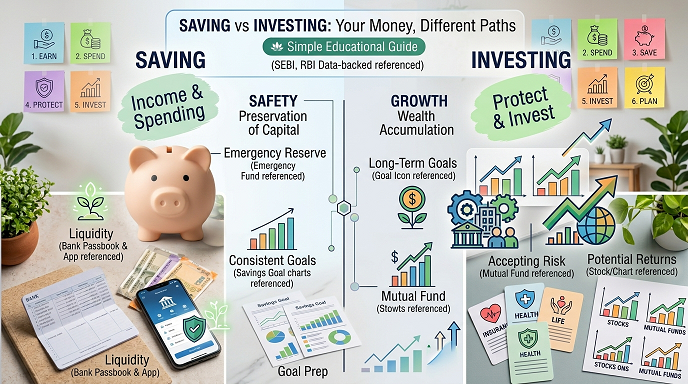
Saving and investing are often used interchangeably, but they serve different purposes.
Saving generally focuses on preserving money for future use and maintaining access to funds.
Investing involves putting money into assets with the expectation of generating returns over time, while accepting some level of risk.
Investment options can include different products such as bank deposits, government schemes, mutual funds, shares, bonds and other financial instruments.
However, different products carry different levels of risk, liquidity, costs and potential returns.
SEBI's investor education resources specifically cover investment products, risk and rewards, securities markets and investor protection.
Therefore, investing shouldn't begin with:
“What is giving the highest return?”
A better starting point is:
“What am I investing for, what risks can I accept, and do I understand the product?”
8. Insurance Helps Manage Certain Risks
Personal finance isn't only about growing money.
It is also about protecting yourself from financial shocks.
Insurance can provide financial protection against specified risks according to the terms of the particular policy.
Depending on individual circumstances, people may consider different forms of insurance, such as health or life insurance.
But insurance products differ significantly.
Before purchasing a policy, understand the coverage, exclusions, premium, policy duration, claim conditions and other relevant terms.
Insurance should be evaluated according to your needs rather than simply because someone recommends a particular product.
9. Financial Goals Give Your Money a Purpose
Managing money becomes easier when you know what you're trying to achieve.
Your goals might include:
Short-term
A vacation, emergency reserve or planned purchase.
Medium-term
Education, a vehicle or a business requirement.
Long-term
Buying a home or planning for retirement.
SEBI's financial education material emphasizes setting financial goals and dividing them into short-term and long-term objectives.
A goal also makes it easier to measure progress.
Instead of saying:
“I want to save more.”
You might say:
“I want to save ₹X toward a specific goal by a particular date.”
The exact amount and timeline will depend on your personal circumstances.
10. Net Worth: A Simple Financial Snapshot
Another useful concept in personal finance is net worth.
In simple terms:
Net Worth = Assets − Liabilities
Your assets could include things such as savings, investments or property.
Liabilities could include loans and other amounts you owe.
SEBI educational material uses net worth as one way to track financial progress over time.
It isn't a complete measure of financial well-being, but it can provide a useful snapshot of your financial position.
More importantly, watching how it changes over time can help you understand whether your overall financial position is improving or becoming more strained.
11. Financial Safety Matters Too
Managing personal finance increasingly means managing digital financial risks.
Online banking, mobile payments and investment platforms have made financial transactions more convenient.
They have also created opportunities for fraud.
NCFE's financial education programs specifically include fraud protection, scams, digital transactions and consumer protection among financial literacy topics.
Some sensible habits include:
- Don't share OTPs or passwords.
- Be cautious with unexpected links.
- Verify financial websites and applications.
- Don't make investment decisions based solely on social media messages.
- Be suspicious of promises of unusually high or guaranteed returns.
- Check whether a financial service provider is appropriately regulated before using its services.
SEBI also provides investor resources focused on fraud awareness and investor protection.
A Simple Personal Finance Framework
If you're just beginning to understand personal finance, don't try to solve everything at once.
Start with these six steps:
1. Know your income
Understand how much money you actually receive.
2. Track your expenses
Record where your money goes.
3. Create a realistic budget
Give your income a clear purpose.
4. Build savings
Set aside money for future needs and unexpected situations.
5. Manage debt carefully
Understand the full cost of borrowing.
6. Plan for the future
Consider appropriate insurance, investments and long-term goals based on your circumstances.
RBI describes financial planning as assessing your current position, identifying future needs, estimating costs and regularly reviewing your progress.
Inkauras Insight
Personal finance doesn't begin when you start investing in the stock market.
It begins much earlier.
It starts when you ask:
Where does my money come from?
Where does it go?
What am I saving for?
What financial risks should I prepare for?
What decisions can I make more carefully?
You don't need to know every financial product available in the market.
Start by understanding your own financial situation.
Final Thoughts
Personal finance is ultimately about making informed decisions about your money.
It includes much more than saving or investing.
Income. Spending. Budgeting. Saving. Borrowing. Insurance. Investing. Financial goals. Protection.
These pieces work together.
There is also no single financial strategy that is right for everyone. A young professional, a business owner, a parent, a retiree and a student may have very different priorities and financial circumstances.
That is why personal finance should be approached as a process of understanding, planning and reviewing rather than following a universal formula.
Start small.
Track your money.
Set realistic goals.
Learn before making financial decisions.
And review your plan as your circumstances change.
The better you understand your money, the more deliberately you can decide what you want it to do.
Finance Disclaimer
This article is provided for general educational and informational purposes only. It is not personalized financial, investment, tax, legal or other professional advice.
Financial products and strategies involve different levels of risk and may not be suitable for everyone. Past performance does not guarantee future results. Before making an investment, borrowing, insurance, tax or other significant financial decision, consider your own circumstances and, where appropriate, consult a suitably qualified and appropriately regulated professional.
Do not make financial decisions solely on the basis of this article.Rate this article
Sign in to rate this article.